








Iron deficiency anaemia is the most common nutritional deficiency on earth, affecting well over a billion people. It is also one of the most treatable — if you know what to look for, because the early signs are easy to attribute to a busy life.
The important distinction is between low iron (stores are empty but haemoglobin is still normal) and iron deficiency anaemia (red cells are now failing). Symptoms can appear at either stage, and treating the second without looking for the cause of the first misses the point entirely.
What iron actually does
Iron has two essential jobs. It sits at the centre of haemoglobin, the protein in red blood cells that carries oxygen from the lungs to every tissue. It is also part of myoglobin in muscle, and it supports enzymes involved in energy production and DNA synthesis.
That explains the symptom list. When there is not enough iron to make haemoglobin, less oxygen reaches your tissues, and your body compensates by working harder — hence breathlessness, palpitations and fatigue. When iron is depleted further, the effects extend to nails, hair, the lining of the mouth and the brain.
9 signs of iron deficiency
Fatigue that does not match your workload
The most common and most dismissed symptom. It is not ordinary tiredness — it is an energy deficit that does not improve with a weekend.
Breathlessness on effort you used to manage
Climbing the same flight of stairs suddenly leaving you winded. The heart also beats faster to compensate for reduced oxygen-carrying capacity.
Craving ice (pagophagia)
A surprisingly specific sign. Chewing ice compulsively is strongly associated with iron deficiency and rarely has another explanation. It is worth mentioning to a doctor unprompted.
Pale skin, conjunctiva and nail beds
Pulling down the lower eyelid and finding the inner rim pale rather than vivid red is a simple self-check. The palms and nail beds are less reliable in darker skin tones — the conjunctiva and nail beds remain more useful.
Brittle nails or spoon-shaped nails
Koilonychia — nails that curve upwards and hold a drop of water like a small spoon — is a classic late sign, alongside nails that split or break easily.
Cracks at the corners of the mouth
Angular cheilitis, together with a sore or unusually smooth tongue (glossitis). These reflect the reduced cell turnover that iron supports.
Hair loss
Diffuse shedding several months after iron falls — the delay reflects the hair growth cycle rather than a sudden event. See our guide to vitamin D deficiency, which produces an overlapping picture.
Restless legs and poor concentration
An irresistible urge to move the legs at rest, worse in the evening, is associated with low iron even before anaemia develops — possibly because brain iron affects dopamine metabolism.
Cold hands and feet, heart pounding
Reduced oxygen delivery plus compensatory circulation changes. Feeling your heart race after mild effort, or noticing palpitations, is worth a blood pressure and blood count check.
What causes it
Bleeding — the cause that must be found
Iron is lost through blood, and the body is very good at conserving it but not at making it. In premenopausal women, heavy menstrual bleeding is the most common cause. In men and postmenopausal women, iron deficiency should be treated as gastrointestinal blood loss until proven otherwise — coeliac disease, ulcers, polyps and, critically, bowel cancer all present this way.
That is the single most important clinical point in this article. A haemorrhoid is the optimistic explanation; it is not the default assumption.
Inadequate intake
Iron comes in two forms with very different absorption:
- Heme iron — from meat, fish and poultry, absorbed at roughly 15–35%
- Non-heme iron — from plants and fortified foods, absorbed at roughly 2–20%
Vegetarians and vegans can absolutely meet requirements, but they need more total iron and stronger attention to absorption enhancers, because the less-efficient source is their only one.
Malabsorption
Coeliac disease is a frequently missed cause at any age. Gastric surgery, inflammatory bowel disease, and chronic use of acid-suppressing medication can all reduce absorption. Coffee and tea taken with meals inhibit non-heme iron — a meaningful habit change rather than a minor footnote.
Increased demand
Pregnancy, adolescence and intensive endurance training all raise requirements. Distance runners develop a well-recognised pattern sometimes called runner’s anaemia, from foot-strike haemolysis, iron loss in sweat and gastrointestinal bleeding.
The numbers worth knowing
| Measure | What it tells you |
|---|---|
| Ferritin | Best single test for stores. Low ferritin is essentially diagnostic of iron deficiency. It is also an acute-phase protein, so inflammation can falsely raise it |
| Haemoglobin | Confirms anaemia but stays normal until stores are long depleted |
| MCV | Low = small red cells, the classic iron picture |
| Transferrin saturation | How much of your transport protein is actually carrying iron |
| TIBC | Rises when the body is trying harder to absorb iron |
Guidelines increasingly treat ferritin below about 30 ng/mL as depleted requiring repletion even with a normal haemoglobin — the “pre-latent” stage where you can fix it before symptoms take hold.
Recommended intakes differ sharply by group: around 8 mg daily for adult men and postmenopausal women, 18 mg for premenopausal women, and 27 mg in pregnancy.
Food sources, and what actually helps absorption
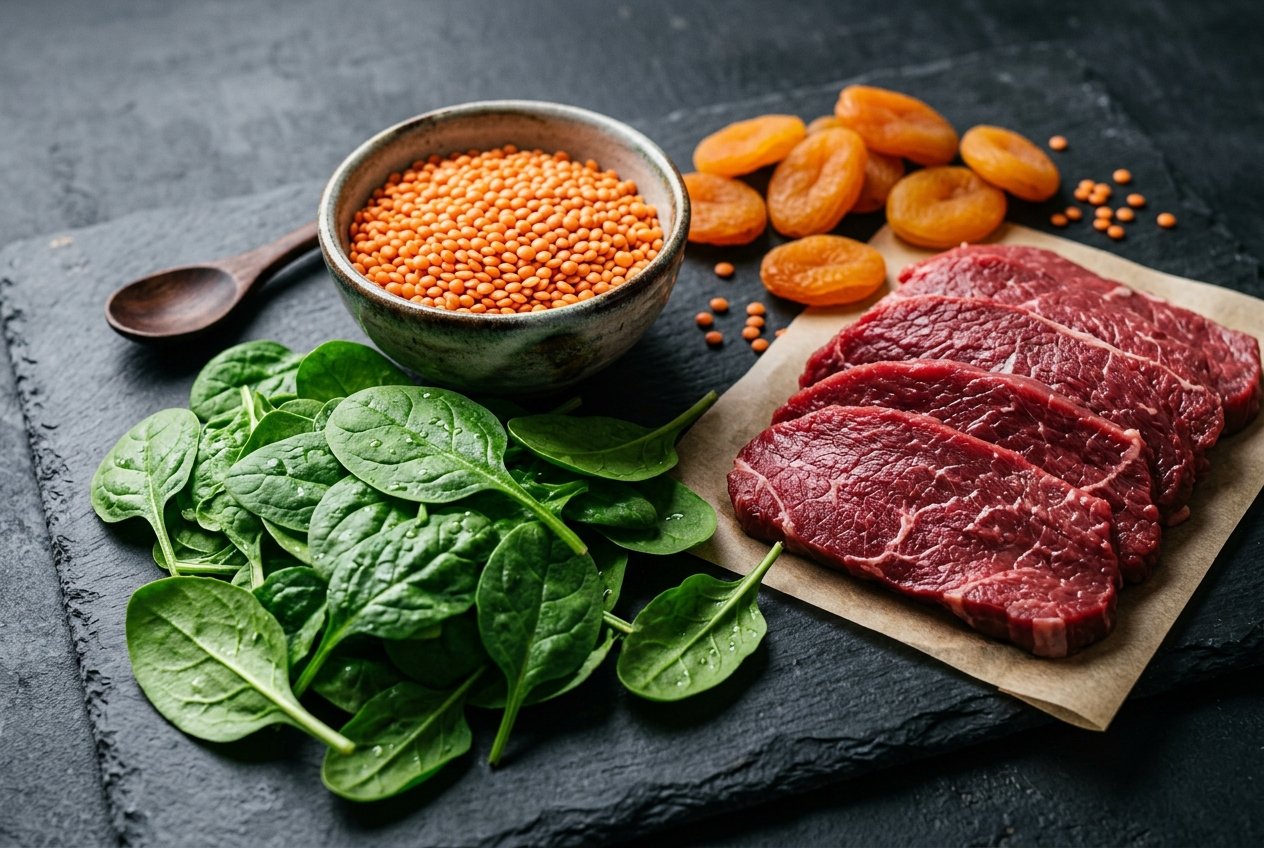
Best heme sources: red meat, liver and organ meats, shellfish (oysters are exceptionally concentrated), poultry, fish.
Best non-heme sources: lentils and beans, tofu, pumpkin seeds, fortified breakfast cereals, dark leafy greens, dried apricots and dates. Spinach is rich in iron by weight but its oxalate content sharply reduces absorption — it contributes, but it is not the workhorse people assume.
Boost absorption
- Vitamin C with the meal — the strongest practical lever, easily doubling or tripling non-heme absorption. Squeezing lemon over lentils or having fruit alongside is a real intervention
- Cooking in cast iron — transfers measurable amounts, particularly to acidic foods
- Separating inhibitors — tea and coffee an hour either side of meals; calcium supplements taken away from iron-rich food
Treatment
Oral iron — ferrous sulfate, fumarate or gluconate — is first-line. Practical points that determine whether it works:
- Take it on an empty stomach with vitamin C for best absorption if tolerated
- If it causes nausea or constipation, alternate-day dosing is often better tolerated and, counterintuitively, absorbs more efficiently because hepcidin is lower the day after a dose
- Take it between meals, and away from tea, coffee, calcium and antacids
- Expect several weeks before energy improves, and three to six months beyond normalisation of haemoglobin to refill stores
Intravenous iron is the route when oral treatment fails, is not tolerated, is contraindicated, or when absorption is genuinely impaired — as in coeliac disease, inflammatory bowel disease or after gastric surgery.
A note on caution: iron is one of the more dangerous supplements to take without testing. Hereditary haemochromatosis causes iron overload, and unsuppressed supplementation accelerates organ damage in people who do not know they have it. Test first.
When to see a doctor
Ask for a full blood count and ferritin if fatigue has persisted more than a few weeks, if you have any of the signs above, if you are vegetarian or vegan and have unexplained symptoms, if you are pregnant or planning pregnancy, or if you have heavy menstrual bleeding.
Men and postmenopausal women with unexplained iron deficiency need a gastrointestinal investigation. That is not alarmist — it is the standard of care, because the deficiency is the symptom and the cause needs a name.
Frequently asked questions about iron deficiency
Should I start iron tablets before being tested?
Not ideally. Testing first tells you whether iron is actually the problem, gives a baseline to measure against, and avoids supplementing when the cause is something else entirely. It also avoids masking a diagnosis if the cause turns out to be blood loss from the gut.
Why does my iron supplement upset my stomach?
Elemental iron irritates the gut lining and alters gut bacteria. Taking it with food reduces side effects but also reduces absorption. If you cannot tolerate daily dosing, alternate-day morning dosing with vitamin C is a well-supported alternative — worth discussing rather than simply stopping.
Is there a difference between anaemia and low iron?
Yes, and it matters. Low iron means stores are empty; anaemia means red cell production has already suffered. You can have significant symptoms at the low-iron stage, and treating only the anaemia number without replenishing stores leaves people symptomatic for months.
Can low iron cause weight gain?
Iron deficiency does not directly cause fat gain. What it does cause is fatigue that reduces activity, and iron is required for thyroid hormone metabolism, so an underactive thyroid picture can overlap. The energy and exercise improvements after repletion are usually what people notice as weight stabilising.
Are plant-based iron sources useless?
No, but they need help. Total intake matters more than per-meal percentage when the diet is well planned, and pairing lentils or tofu with a genuine vitamin C source meaningfully changes absorption. Simply eating more spinach without attention to enhancers and inhibitors is the approach that underperforms.
This article is for general information only and is not a substitute for professional medical advice. See our medical disclaimer.