










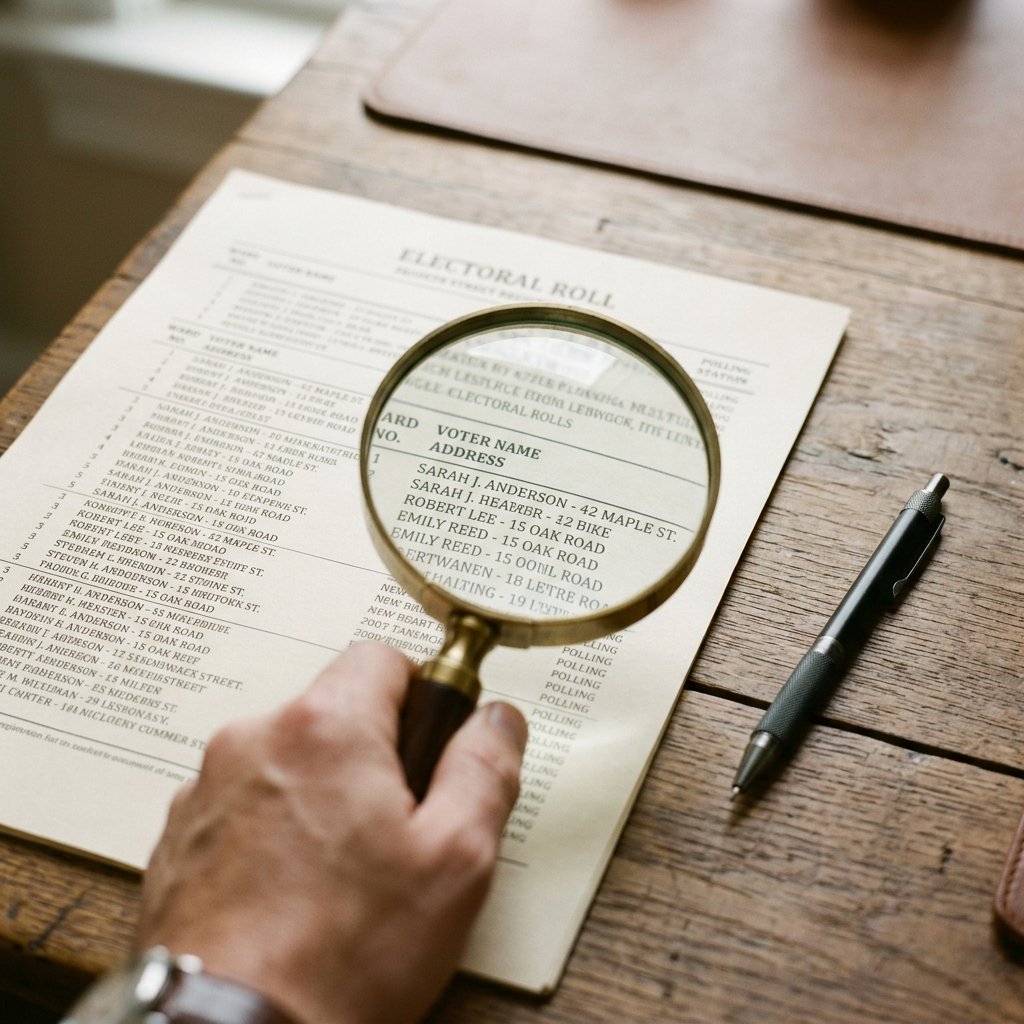
The case for the Special Intensive Revision rests on a simple idea: a democracy cannot be better than the roll it votes on. If the electoral roll contains dead people, duplicate names, people who moved away years ago and entries that cannot be verified, then every election built on that roll carries avoidable risk. SIR is the ECI’s attempt to rebuild the roll from the household up. Here are the benefits supporters point to, and the conditions that determine whether they are realised.
1. It removes dead voters from the roll
Dead electors are the clearest example of a roll that has drifted. A name is rarely removed automatically when a person dies; families must report it, and many do not. Over years, constituencies accumulate entries for people who cannot vote. Removing them is not a political act. It is basic maintenance, and it reduces the pool of names that could be misused.
2. It removes duplicate entries
Duplicates arise when the same person is registered in two places, or when a family member’s details are entered twice. They distort the size of the electorate, complicate booth-level planning and create the possibility of one person voting more than once. Matching and de-duplication are core parts of SIR. A roll where each eligible person appears once is easier to defend and easier to audit.
3. It updates people who have shifted
India is a country of internal migration. People move for work, marriage and education, but their voter registration often stays behind. An elector who has lived in a city for a decade may still be listed in their home village. SIR’s door-to-door verification is designed to identify these cases and move or remove entries so that the roll reflects where people actually live. That makes representation more accurate and reduces the chance of impersonation at the old address.
4. It makes impersonation harder
Bogus voting needs a name to vote under. Dead entries, duplicate entries and unverifiable entries are the raw material. A roll that has been verified household by household, with documents and photographs, is harder to exploit. Supporters argue that this is the single biggest practical benefit: it raises the cost of the fraud that the roll itself makes possible.
5. It makes turnout and demographic data more honest
Turnout is calculated as votes cast divided by electors. If the denominator includes dead and duplicate names, turnout is understated and the gap between registered and actual voters is misread. Cleaner rolls produce more accurate turnout figures, better age and gender profiles, and better planning for polling stations, staff and security. Every one of those is a public good, regardless of which party wins.
6. It strengthens the link between the roll and public services
The electoral roll is one of the most widely used identity and address records in India. It is used for ration cards, welfare schemes, and as proof of residence. An inaccurate roll propagates inaccuracy into those systems. A verified roll improves the targeting of benefits and reduces the scope for both exclusion and leakage. This is a quieter benefit than cleaning up elections, but it affects millions of people every day.
7. It meets a legal duty and restores confidence
The ECI is constitutionally responsible for free and fair elections. Section 21(3) of the Representation of the People Act, 1950 allows a special revision when reasons are recorded. The Supreme Court, in its 27 May 2026 judgment, upheld the Bihar SIR and held that the exercise was within the ECI’s mandate and not manifestly arbitrary. That legal validation matters: it means the exercise is not a novelty outside the law, but an available statutory tool that the Commission chose to use.
Confidence matters as much as legality. If a large section of the public believes the rolls are padded, every close result is contested. A credible, documented clean-up gives losing parties less room to claim the roll was rigged, and gives winners a stronger mandate.
8. It creates a record for future revisions
SIR is not only about this election. The household-level data, the document trail and the mapping of shifts create a baseline that future revisions can update rather than rebuild. If the process is done well, the next revision should be cheaper, faster and less disruptive. That is the institutional benefit: a one-time investment in a better roll.
What the critics say
The benefits are real only if the errors are contained. Critics, including Human Rights Watch and several civil-society groups, argue that the process has been opaque and that a large share of deletions were for “absent or shifted” reasons that are easy to misapply. They point to people who voted in 2025 and were missing in 2026, and to a disproportionate impact on women, poor households and minorities. Those are serious claims, and they are not answered by saying the roll needed cleaning. A clean roll that removes eligible voters is not a success; it is a different failure.
The honest position is that both things can be true. The roll needed revision, and the revision has produced errors that must be corrected. The independent commission of former judges, due to report by December 2026, exists precisely to test the gap between the two.
Read first: what SIR is and how it works.
What would make the benefits real
- Fast, accessible appeals: a voter who is wrongly removed should be able to get back on the roll before the next election, without a lawyer.
- Transparent category data: publish how many deletions fall into each category, state by state, so the “absent or shifted” share can be audited.
- Independent verification: let the commission and outside experts check a sample of deletions against household data.
- Clear communication: tell people what document is needed, in local languages, before the deadline.
- Correction without blame: fix errors quickly and publish the correction rate.
Frequently asked questions
What is the main benefit of SIR?
It removes dead, duplicate and unverifiable entries and updates electors who have shifted, which makes the roll more accurate and makes impersonation harder.
Does SIR reduce the number of voters?
It can, because dead and duplicate entries are removed. The ECI says eligible voters are not the target. The dispute is over how many eligible people were removed by mistake.
Did the Supreme Court approve SIR?
Yes. On 27 May 2026 the Supreme Court upheld the Bihar SIR and held that it was within the ECI’s statutory mandate, while setting limits on citizenship inquiries.
Is a cleaner roll good for democracy?
In principle, yes. Accurate rolls make turnout data reliable, reduce fraud risk and strengthen the credibility of results. The benefit depends on correcting wrongful exclusions.
What happens to people wrongly deleted?
They can file Form 6 or use the claims and objections process, then appeal to the District Magistrate and Chief Electoral Officer. The independent commission is also examining the error rate.