









Tinnitus is the name for hearing noises that do not come from an outside source. The NHS describes it as ringing, buzzing, whooshing, humming, hissing or throbbing, and says it is not usually a sign of anything serious and may get better by itself.
This guide explains what a tinnitus assessment involves, what can cause tinnitus, which treatments and self-help measures the NHS describes, and where to get tinnitus assessment and management in Australia, including clinics on the Gold Coast, in Tasmania, and in Brisbane and Moreton Bay.
What tinnitus sounds like
The NHS lists these sounds as possible forms of tinnitus: ringing, buzzing, whooshing, humming, hissing, throbbing, and music or singing. You may hear them in one or both ears, or in your head. They may come and go, or be constant.
What causes tinnitus
It is not always clear what causes tinnitus. The NHS says it is often linked to:
- some form of hearing loss
- Ménière’s disease
- conditions such as diabetes, thyroid disorders or multiple sclerosis
- anxiety or depression
- some medicines, including some chemotherapy medicines, antibiotics, NSAIDs and aspirin
Earwax build-up and ear infections can also be causes, which is why a GP will look in your ears first. Our guide to ear wax build-up explains the safe options.
When to see a doctor
The NHS advises seeing a GP if:
- you have tinnitus regularly or constantly
- your tinnitus is getting worse
- it bothers you, for example by affecting your sleep or concentration, or by making you feel anxious or depressed
Ask for an urgent GP appointment if your tinnitus beats in time with your pulse. The NHS advises going to A&E or calling 999 if you have tinnitus after a head injury, or tinnitus with sudden hearing loss, weakness in the muscles of the face, or a spinning sensation (vertigo).
What a tinnitus assessment involves
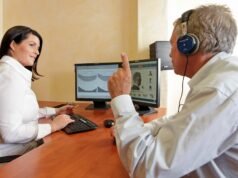
The NHS says a GP will look in your ears to see whether your tinnitus has a treatable cause, such as an ear infection or earwax build-up, and may check for hearing loss. You may then be referred to a specialist for further tests and treatment.
The NHS says a GP may also check for hearing loss, because it is one of the common links with tinnitus. Our guide to hearing assessments describes each test.
Management options
There is no single treatment that works for everyone. The NHS describes the following approaches.
Self-help
The NHS suggests:
- trying to relax, for example with deep breathing or yoga
- improving sleep with a bedtime routine and by cutting down on caffeine
- avoiding things that can make tinnitus worse, such as stress or loud background noise
- joining a support group, since talking to other people with tinnitus may help
- using sound therapy, such as soft music or background sounds, rather than total silence
- keeping busy with hobbies and activities, rather than focusing on the tinnitus
Talking therapies
If the cause cannot be treated, a GP or specialist may refer you for talking therapy. The NHS lists three options:
- Cognitive behavioural therapy (CBT). Changes the way you think about tinnitus and reduces anxiety. Digital CBT, delivered through an online programme or app, is usually offered first.
- Tinnitus counselling. Helps you understand tinnitus and find ways of coping with it.
- Tinnitus retraining therapy. Uses sound therapy to help the brain become less aware of the tinnitus. The NHS says it may be available on the NHS for people with severe or persistent tinnitus, that it is unclear whether it works for everyone, and that it is widely available privately.
Hearing aids
If you have hearing loss, the NHS says hearing aids may be recommended. The NHS does not describe hearing aids as a cure for tinnitus.
Tinnitus services in Australia
The following clinics list tinnitus assessment and management as a service. Check each clinic’s current services and booking requirements before you visit.
- Simply Hearing (Gold Coast): tinnitus management, with clinics at Broadbeach, Pimpama and Hope Island. The clinic says its accredited clinicians help assess and manage tinnitus. Visit simplyhearing.com.au or call +61 422 388 005.
- Revive Hearing (Tasmania): Tinnitus Assessment and Management, with clinics in Beaconsfield, South Launceston, Lilydale and Legana. Visit revivehearing.com.au or call 0484 864 941.
- Clear Hearing Solutions (Brisbane and Moreton Bay): Tinnitus Assessment and Management, with clinics in Hamilton, Thornlands and Caboolture. Visit clearhearingsolutions.com.au or call 07 5319 2444.
If you live elsewhere in Australia, your GP can advise on local audiology services.
Questions to ask at your appointment
- Is there a treatable cause, such as earwax or a medicine I am taking?
- Do I have hearing loss that hearing aids could help?
- Which self-help strategies or talking therapies would suit me?
- How will we track changes over time?
- Which parts of the plan are funded, and what would they cost privately?
Frequently asked questions
Can tinnitus be cured?
The NHS says tinnitus is not usually a sign of anything serious and may get better by itself. It does not state that tinnitus can be cured, and there is no treatment that works for everyone. Treatment aims to help you cope with it and reduce how much it affects you.
Is tinnitus a sign of something serious?
The NHS says it is not usually a sign of anything serious. Tinnitus that beats with your pulse, follows a head injury, or occurs with sudden hearing loss, facial muscle weakness or vertigo needs urgent medical attention.
Can stress make tinnitus worse?
The NHS lists stress as something that can make tinnitus worse, and suggests relaxation methods to help you cope.
Do I need a referral for a tinnitus assessment?
This depends on the clinic and how the assessment is funded. Ask the clinic before booking. Your GP can also refer you to a specialist.
Sources
- NHS, “Tinnitus,” Health A to Z, page last reviewed 12 January 2024: nhs.uk
- NHS, “Hearing loss,” Health A to Z, page last reviewed 30 May 2025: nhs.uk
- Simply Hearing, tinnitus management service, accessed for this article: simplyhearing.com.au
- Revive Hearing, Tinnitus Assessment and Management service, accessed for this article: revivehearing.com.au
- Clear Hearing Solutions, Tinnitus Assessment and Management service, accessed for this article: clearhearingsolutions.com.au
This article is general information, not medical advice. It does not replace an assessment by a GP, audiologist or other qualified health professional. The clinics listed are named for reference only, and their services and fees may change. Tinnitus that is sudden, pulsing, follows a head injury, or occurs with hearing loss, facial weakness or dizziness needs urgent medical care.