









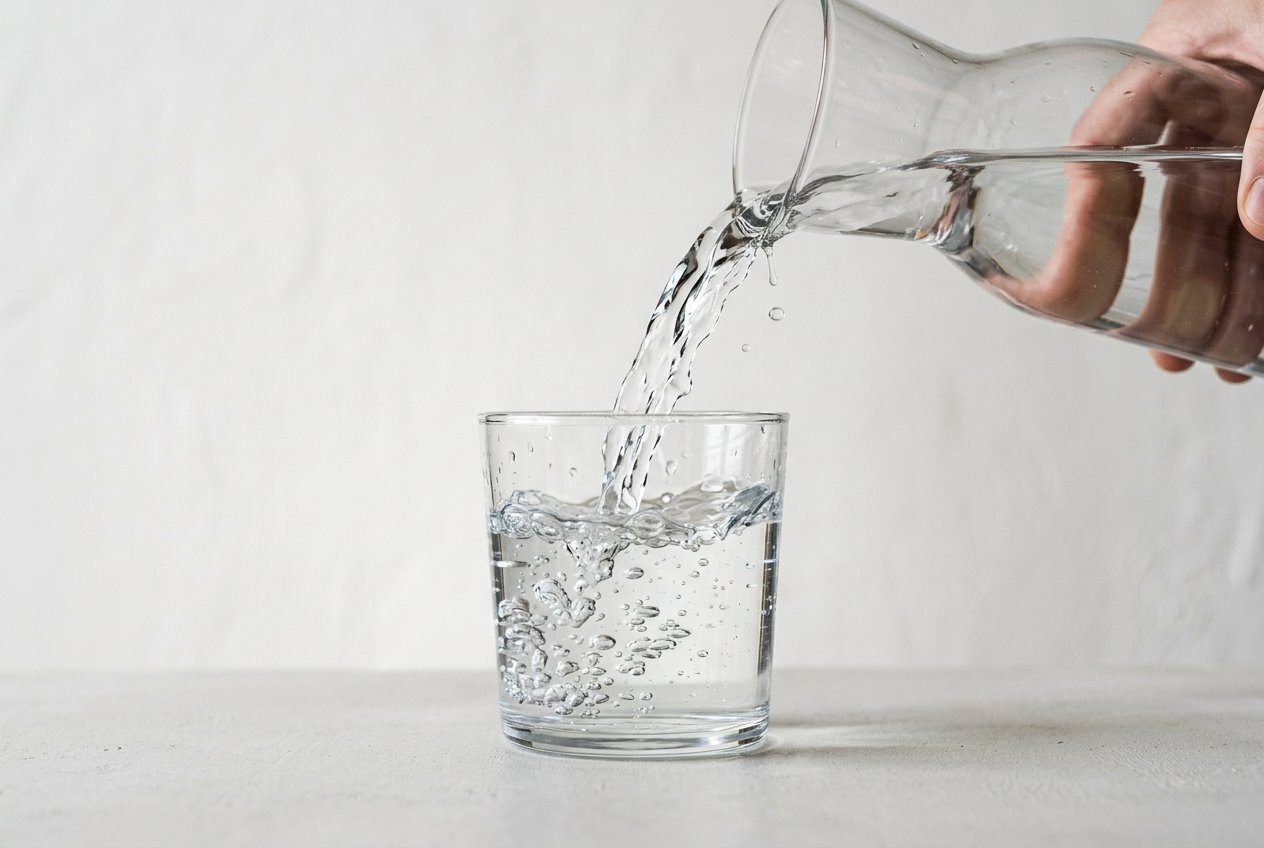
“Drink eight glasses of water a day” is probably the most repeated nutrition instruction in the English language, and it has almost no scientific origin. It traces back to a 1945 recommendation from the US Food and Nutrition Board that stated a figure — and then added, in the sentence almost nobody quotes, that most of that quantity is contained in prepared foods.
The honest answer to how much you need is more useful than a single number: it depends on your body size, your activity, your climate, and what you eat.
The actual numbers
Two different figures circulate because they measure different things — total water (everything you take in) versus drinking water (just beverages).
| Source | Women | Men | What it counts |
|---|---|---|---|
| European Food Safety Authority | 2.0 L/day | 2.5 L/day | Total water, food included |
| US Institute of Medicine | 2.7 L/day | 3.7 L/day | Total water; about 20% from food |
| The “8 glasses” rule | 1.9 L | 1.9 L | Drinking water; no strong evidence base |
Typical diets provide roughly 20% of intake from food — more if you eat a lot of fruit and vegetables. So a reasonable working target for most adults is somewhere around 6–8 glasses of fluid daily, adjusted for the factors below. That is a starting point, not a target to be hit regardless of circumstances.
When you need more
- Heat and humidity — sweating losses can be litres per hour
- Exercise — particularly sessions beyond an hour
- Fever, vomiting or diarrhoea — losses here can be rapid and dangerous
- Breastfeeding — additional fluid requirement
- Pregnancy — recommended intake rises to around 3 L of fluids daily
- Altitude — increased respiration and urine output
- High-protein or high-salt diets — increased renal water requirement
When you need less — the important caveat
Some conditions require fluid restriction rather than more fluid:
- Advanced kidney disease
- Heart failure, where the circulation cannot handle the volume
- Certain liver conditions with ascites
For these people, “drink more water” is actively harmful advice. If you have any of these, your fluid target comes from your clinician, not from this article.
What counts, and what does not
Counts toward your intake: water, milk, herbal and ordinary tea, coffee, juice (though the sugar content matters), soup, and water-rich foods — cucumber and lettuce are about 96% water, watermelon about 92%, oranges about 87%.
The coffee question: the claim that caffeinated drinks do not count, or worse, actively dehydrate you, is largely a myth. Moderate coffee intake — up to around four cups — produces net hydration in regular consumers. Caffeine is a mild diuretic, but the fluid volume more than offsets it.
Alcohol genuinely does not count. It suppresses antidiuretic hormone, so you produce more dilute urine than the volume you drank, which is a real contributor to the dehydration behind hangovers.
Reading the signals
Urine colour
The most practical tool available, and better than any schedule:
- Pale straw — generally adequate
- Dark amber — you likely need more
- Completely clear — not the goal; it suggests over-drinking
Caveats: first morning urine is concentrated and expected to be dark; riboflavin (vitamin B2) turns urine bright yellow; nitrofurantoin, some B vitamins, beetroot, asparagus and certain antibiotics all alter colour. Do not chase clear urine if you are taking any of these.
Is thirst reliable?
For healthy adults, largely yes — the common claim that thirst means you are “already dehydrated” is overstated. The thirst mechanism triggers at roughly 1–2% body mass deficit, which is mild, and it does a reasonable job of regulating intake when fluid is available.
Thirst becomes a poorer guide in older adults (reduced sensitivity), in infants, during sustained heavy exercise in heat, and during illness. In those situations, deliberate intake matters more.
Signs you are behind
Headache, dry mouth, tiredness, dizziness, reduced urination, darker urine, and constipation. Even mild dehydration — around 1–2% of body mass — measurably affects concentration, mood and short-term memory, which is one reason it is worth managing in school and at work.
Severe dehydration — confusion, rapid heartbeat, fainting, very low blood pressure, sunken eyes, minimal urine — is a medical emergency, particularly in children and older adults.
The opposite problem: too much water
Hyponatraemia — dangerously low blood sodium from dilution — is real and occasionally fatal. It most commonly affects endurance athletes who drink far more than they lose, but it can also occur with certain psychiatric conditions and after ecstasy use at raves.
Symptoms: nausea, headache, confusion, muscle twitching, and in severe cases seizures and coma.
The key principle: drink to thirst during exercise under an hour. For sessions beyond 60–90 minutes, a plan that includes electrolytes — and that does not exceed your losses — is appropriate. Drinking more than you sweat is the risk, not less.
Where extra water clearly helps
- Kidney stones — the strongest evidence. Higher fluid intake increases urine volume, dilutes stone-forming minerals, and reduces recurrence. Stone formers are typically advised to exceed 2.5 L of urine daily
- Constipation — particularly effective when combined with fibre, as soluble fibre needs fluid to form bulk
- Urinary tract infections — the benefit is more modest than commonly claimed; increased voiding does help, but it is not a substitute for treatment
- Bladder health — adequate intake supports regular emptying
Making it actually happen
- Keep water visible — a bottle on the desk is more effective than an intention
- Pair it with an existing habit — a glass on waking, one with each meal
- Check urine before deciding — one glance replaces guesswork
- Use food — soups, fruit, salads and curries contribute meaningfully
- Don’t force it — if you are pale-straw and comfortable, you are done. Hydration is a physiological state, not a score
Frequently asked questions about water intake
Does tea and coffee count?
Yes. Moderate caffeinated drinks contribute to hydration in regular consumers. The old rule that a cup of tea “costs” you net fluid does not hold at normal intakes. Herbal teas, milk and juice count as well, though juice brings sugar.
Is eight glasses a day a real requirement?
No. It is a round number with a weak provenance, and it ignores body size, climate, activity and dietary water content. A 60 kg person in a cool climate doing desk work and a 95 kg person working outdoors in heat have genuinely different needs. Use thirst, urine colour and circumstances rather than a fixed count.
Can you drink too much?
Yes — hyponatraemia from over-drinking is a recognised cause of hospital admissions, particularly at marathons. The risk comes from consuming substantially more than you lose. More water is not more healthy; matching intake to output is.
Will drinking water help me lose weight?
Partially and indirectly. Drinking water before a meal modestly reduces intake in some people, and replacing sugary drinks with water removes a meaningful number of calories. But water is not a weight-loss intervention on its own, and claims that cold water “burns fat” are negligible in practice.
Do I need to worry if my urine is always dark?
If you drink normally and it stays dark, it is worth a check — kidney function, medication effects and dietary factors are all possibilities. If it varies with intake, it is simply doing its job as a gauge. Persistent dark urine alongside swelling, foamy urine or reduced output should be assessed properly.
This article is for general information only and is not a substitute for professional medical advice, particularly if you have kidney, heart or liver disease. See our medical disclaimer.