










India holds roughly 8% of the world’s recorded species across about 2.4% of its land area, which makes it one of the few countries that qualifies as both a mega-diverse nation and a biodiversity hotspot. It also has one of the highest densities of human population on earth, and that collision — habitat versus livelihood — is the thread running through almost every story on this list.
The Wildlife Protection Act of 1972, Project Tiger from 1973 and CITES membership form the legal backbone. Against that, ten species remain at serious risk.
10 endangered animals in India
1. Great Indian Bustard — Critically Endangered
The most at-risk bird on this list. Fewer than a couple of hundred survive, concentrated in the grasslands and scrub of Kutch in Gujarat and parts of Rajasthan. Grasslands are among the least protected ecosystems in India — historically treated as wasteland rather than habitat.
The clearest and most fixable threat is collision with overhead power lines, which the birds cannot see during their low, heavy flight. Conversion of those lines to underground cabling, and the fitting of bird diverters where burial is not possible, is the single most consequential conservation action available for this species.
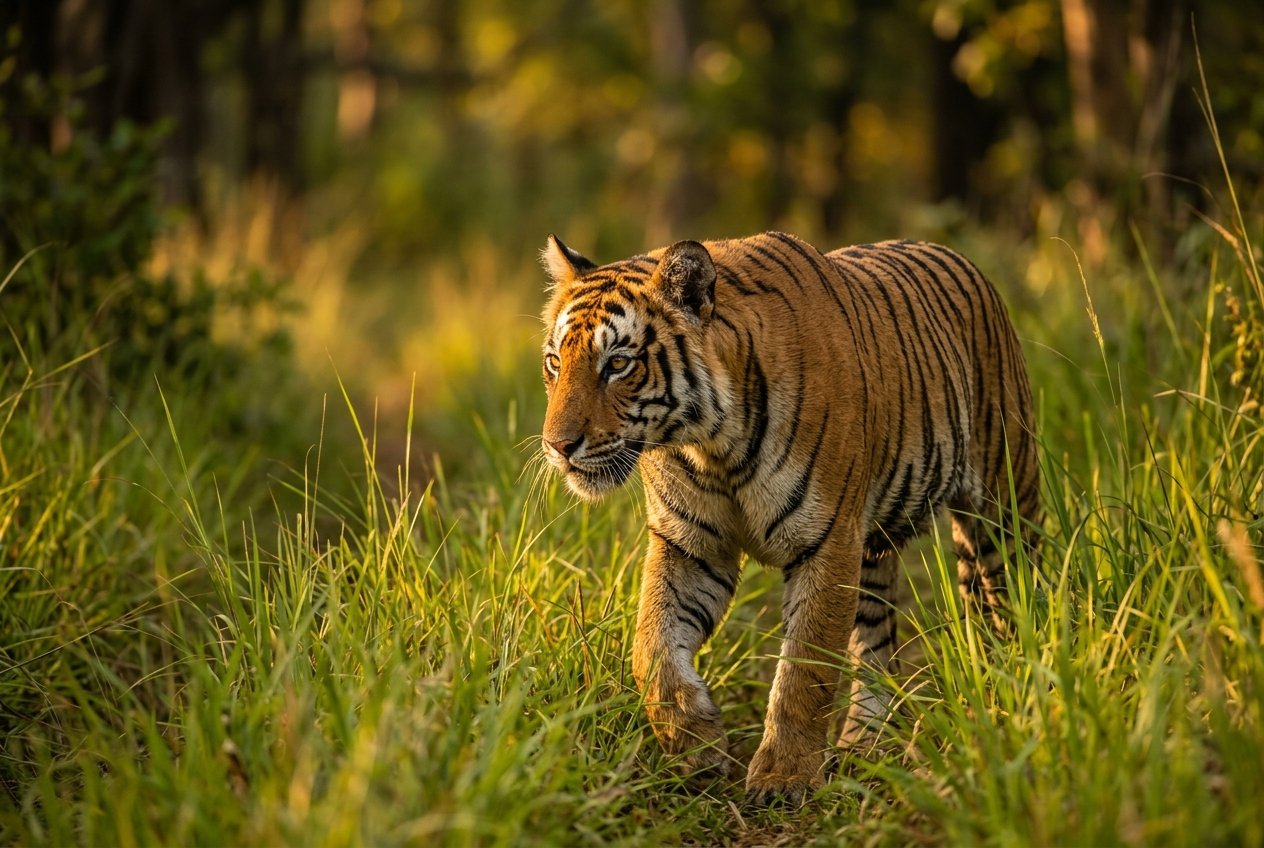
2. Bengal Tiger — Endangered
The success story that still is not finished. Project Tiger, launched in 1973, established a network of reserves that brought the population back from a dangerous low; the most recent national camera-trap census recorded roughly 3,600 tigers. India now holds around three-quarters of the world’s wild tigers.
The remaining pressures are habitat fragmentation, conflict at the forest edge when tigers leave reserves, and poaching driven by the illegal trade in parts. A tiger that cannot move between protected areas is a population slowly being cut into smaller, less viable pieces.
3. Asiatic Lion — Endangered
Confined almost entirely to the Gir Forest and surrounding districts of Gujarat — a single population, which is precisely the risk. Numbers have recovered impressively from the early twentieth century to around 600–700 animals.
One catastrophic disease outbreak, one severe drought, or a single major infrastructure project could undo decades of recovery. Proposals to establish a second population elsewhere have been discussed for years without resolution, which remains the central strategic vulnerability.
4. Indian Elephant — Endangered
The largest land animal in India, and the one in most frequent direct contact with people. As forests fragment, elephant corridors — the routes they have used for generations — get cut by roads, railways and settlements.
The result is escalating human-elephant conflict: crop damage, property loss, and fatalities on both sides. Corridor protection is the core intervention, because the conflict is not caused by elephants changing behaviour but by their routes being blocked.
5. Gharial — Critically Endangered
A fish-eating crocodilian with a distinctive long, narrow snout, once found across the northern river systems. Numbers fell sharply through the twentieth century and it now survives in a handful of stretches of the Chambal, Girwa and Mahanadi.
Dam and irrigation projects altered river flow and temperature, sand mining destroyed nesting banks, and overfishing removed its food supply. It is far less dangerous to humans than other crocodilians, which has not protected it from being killed out of fear.
6. Kashmir Red Stag (Hangul) — Critically Endangered
Endemic to the valleys of Kashmir, restricted to a small area around Dachigam and a few adjacent reserves. The population was reduced to very low numbers by hunting and habitat pressure.
Its entire range is compact, which makes it exceptionally vulnerable to a single land-use decision or disturbance event.
7. Nilgiri Tahr — Endangered
A stocky mountain goat found only in the Nilgiri Hills and the southern Western Ghats, living on steep grassy escarpments. Suitable habitat has been reduced by tea and timber plantations, tourism infrastructure and expansion of non-forest land use.
It is the state animal of Tamil Nadu and a symbol of the Western Ghats, but its habitat remains fragmented across reserves rather than forming a continuous range.
8. Indian Pangolin — Endangered
The most trafficked mammal in the world. Its scales are demanded in illegal traditional medicine markets and its meat is considered a delicacy in some places, despite scales being made of keratin — the same material as fingernails.
Because it is nocturnal, solitary and burrows underground, population estimates are unreliable. Enforcement against trafficking is the decisive factor, along with demand reduction in destination markets.
9. Caracal — Endangered in India
A medium-sized wild cat with distinctive black-tufted ears, historically found across dry deciduous and scrub habitats. Habitat loss, depletion of its prey base and persecution by pastoral communities who view it as a livestock threat have driven steep declines.
Its global IUCN status is less severe than its status within India specifically, which is why national-level protection matters for this species.
10. Indian Wild Ass — Endangered
Restricted to the Little Rann of Kutch and adjoining areas — one of the last populations of a subspecies that once ranged far more widely. The habitat is saline desert that supports little else.
Hybridisation with domestic donkeys, disease transmitted from livestock, and encroachment on grazing ground are the main pressures. The Rann is protected as a sanctuary, but the range itself is geographically tiny.
The four threats behind the list
Habitat loss and fragmentation
The dominant pressure. Forests, grasslands and wetlands converted or carved up — and even where habitat is formally protected, being broken into isolated patches reduces genetic diversity and makes local extinction far more likely.
Poaching and illegal trade
Organised trafficking for skins, scales, bones, horns and live animals. It is a transnational criminal market, which is why enforcement and demand reduction matter as much as habitat protection.
Human-wildlife conflict
When habitat shrinks, encounters increase — and the cost falls on both sides. Farmers losing a season’s crop and communities losing lives to conflict are not opponents of conservation; they are people absorbing its costs without adequate compensation or mitigation.
Infrastructure and linear barriers
Power lines, roads, railways and canals cut through habitats. For a bird like the Great Indian Bustard they are lethal; for elephants they are impassable; for river species they are barriers to movement and flow.
What actually works
- Protected area networks with connectivity. Reserves matter most when wildlife can move between them.
- Corridor protection. Securing the routes animals already use, ahead of development rather than after conflict starts.
- Underground cabling and bird diverters — a targeted, technically simple fix for the Great Indian Bustard.
- Community participation with compensation. Conservation that leaves local people worse off does not hold.
- Tackling demand at source. Trafficking persists because markets exist; enforcement alone has never been sufficient.
- Restoring degraded habitat. Grasslands and scrub need the same restoration attention forests receive.
For how ecosystem recovery looks when it works, our piece on how natural fires help native bees shows a case where the right disturbance produced better outcomes than preventing it, and disappearing snakes and the biodiversity crisis covers a less charismatic group whose decline has consequences all the way up the food chain.
What an individual can do
- Choose certified and verified products — avoid anything derived from wild animals, including scales, ivory and exotic pets.
- Report wildlife sightings responsibly. Geotagged public posts have led poachers directly to rare animals.
- Support organisations doing habitat work rather than only those that rescue individual animals; the photo-worthy rescue is the small part.
- Reduce plastic and waste pressure on habitats — our piece on plastic pollution reaching Antarctica illustrates how far waste travels.
- Press for corridor protection before new infrastructure is approved, not after.
Frequently asked questions
How many tigers are left in India?
The most recent official camera-trap census recorded roughly 3,600 wild tigers, making India home to the large majority of the world’s remaining Bengal tigers. Estimates vary slightly between census methods, so the trend over successive surveys matters more than any single figure.
What is the rarest animal in India?
The Great Indian Bustard is among the rarest, with a wild population now measured in the low hundreds. The Kashmir red stag and certain freshwater species are similarly restricted to very small areas.
Can Project Tiger continue to succeed?
Population recovery shows the model works when reserves are well funded and protected. The next phase is harder — connectivity between reserves, and conflict reduction outside them — because it requires coordination beyond park boundaries with human communities living there.
Why protect animals nobody cares about?
Because ecosystems are not a menu. Snakes, insects and scavengers control pests, disperse seeds and recycle nutrients; their loss shows up in agricultural damage and disease risk long before anyone notices the species itself. Conservation that only protects charismatic animals leaves the system underneath them failing.
IUCN categories and population figures change as surveys are published — check the IUCN Red List for the current status of any species.






[…] 10 Endangered Animals in India and How to Save Them […]