










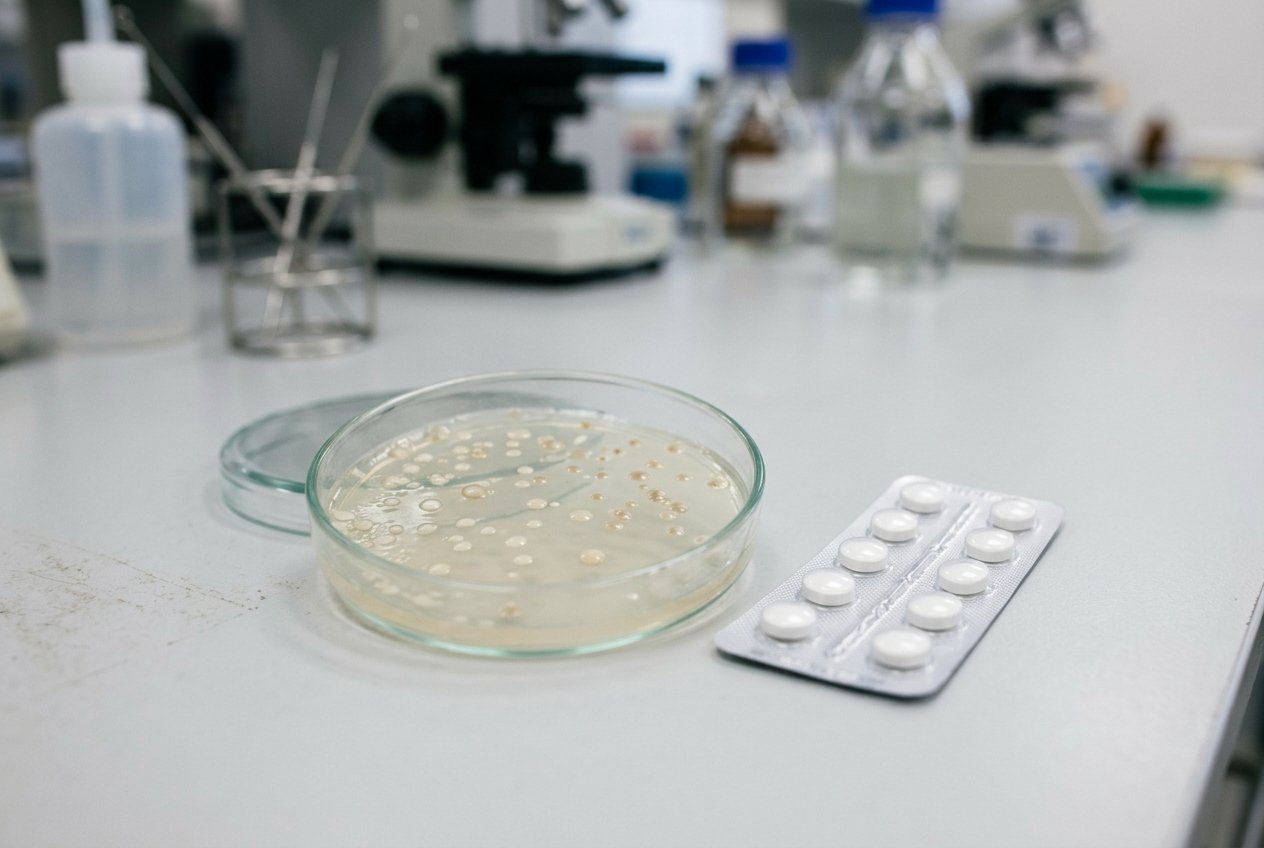
Antibiotic resistance is often described as bacteria “learning to outsmart” medicine. That framing is wrong, and the correction matters: bacteria do not learn anything from antibiotics. They die, or they do not — and the ones that do not were already resistant before treatment began.
Every antibiotic course is a selection experiment. Understanding that mechanism is the difference between interventions that actually slow resistance and gestures that do nothing.
How resistance actually develops
Bacteria reproduce quickly and carry mutations at a predictable rate. In any large population — and a gram of gut bacteria numbers in the trillions — variants conferring resistance already exist before a drug is ever taken.
- An antibiotic is introduced
- Susceptible bacteria are killed or prevented from reproducing
- Resistant individuals, unaffected, now face no competition
- They multiply to fill the vacated niche
- The population that remains is predominantly resistant
This is Darwinian natural selection operating on a timescale of hours. Nothing was learned. The drug did not create the resistance; it removed the alternative.
How resistance spreads between bacteria
What makes this worse than simple mutation is that bacteria do not only inherit genes vertically from their parent. They exchange them sideways:
- Conjugation — direct transfer of a plasmid between cells through a pilus. Plasmids frequently carry several resistance genes at once, so one transfer can confer resistance to multiple drugs simultaneously
- Transformation — picking up free DNA from dead bacteria in the environment
- Transduction — a bacteriophage accidentally carrying bacterial DNA from one cell to another
Resistance genes can therefore jump between species. A gene that evolved in one soil organism can end up in a human pathogen. For how these genes are physically structured and exchanged, our explainer on what DNA is covers the underlying machinery.
The mechanisms bacteria use are diverse: enzymes that destroy the drug (beta-lactamases), pumps that expel it, alterations to the drug’s target, and reduced uptake through changed membrane channels.
What accelerates it
In human medicine
- Prescribing when not needed — antibiotics have no effect on viral infections, yet they are widely requested and prescribed for colds, flu and most sore throats
- Broad-spectrum drugs used when a narrow one would do — hitting the entire gut flora rather than one organism creates selection pressure across billions of bacteria
- Infection control failures in healthcare settings — hospitals concentrate both vulnerable patients and resistant organisms
- Travel and global movement — resistance acquired anywhere spreads everywhere
In agriculture
A very large proportion of antibiotics sold globally are used in animals — historically including for growth promotion rather than treatment. This creates environmental reservoirs of resistance genes in soil, water and food chains. Reducing routine agricultural use is one of the higher-yield interventions available, and several countries have restricted it with measurable effect.
The economic problem
Developing antibiotics is commercially unattractive: they are taken for days rather than lifelong, stewardship deliberately limits their use, and the newest classes are held in reserve. The result is a pipeline that has largely stalled while resistance has not. This is a market failure rather than a scientific one.
How big is the problem
Antimicrobial resistance is ranked by the WHO among the most serious global public health threats. The landmark GRAM study estimated roughly 1.27 million deaths directly attributable to bacterial resistance in 2019, with several million more associated with it — a figure comparable to HIV and malaria deaths combined.
The organisms most familiar to the public illustrate the range: MRSA in skin and bloodstream infections, drug-resistant E. coli in urinary and abdominal infection, extensively drug-resistant tuberculosis, and resistant gonorrhoea. CRE — carbapenem-resistant Enterobacteriaceae — are among the hardest to treat and are a major hospital concern.
Many of these infections are still treatable. The trajectory, rather than the current position, is what alarms specialists: we are losing drugs faster than we are replacing them.
Common misconceptions
“Antibiotics are becoming less effective in me because I take too many”
You do not become resistant — your bacteria do, and the resistant strains you acquire or select for are then transmissible. The pressure applied to your own flora is real and matters, but the resistance itself can spread to other people.
“I should stop antibiotics as soon as I feel better”
Take them exactly as prescribed. Short courses are increasingly supported by trials for some specific infections, which has caused genuine scientific debate — but that is a decision about regimen design for a defined diagnosis, not a licence to stop early on your own judgement. Dosing that never achieved adequate duration is a textbook way to select for resistance.
“Natural antibiotics are safer”
Natural does not mean selective. The mechanisms that kill bacteria damage you too, and dosing that fails to clear an infection selects for resistance just as effectively as a prescribed drug taken incorrectly.
“Antibiotics help me get over colds faster”
They do not, and taking them anyway provides no benefit while adding selection pressure and exposing you to side effects such as Clostridioides difficile infection. Most sore throats are viral; the minority caused by streptococcus are diagnosed before treating.
What actually slows it down
- Vaccination — preventing infection is the cleanest possible intervention. Every prevented pneumonia or urinary infection is an antibiotic that never needed to be used. Our explainer on how vaccines work covers why this works at the immune level
- Infection prevention — hand hygiene, water and sanitation, food safety, and hospital infection control reduce infections at source
- Better diagnostics — rapid tests that distinguish bacterial from viral infection, and that identify the organism and its susceptibilities within hours rather than days
- Stewardship — narrowing spectrum, shortening duration where evidence supports it, and reviewing prescriptions
- Agricultural restriction — removing routine non-therapeutic use
Vaccines and sanitation deliver more antibiotic-sparing benefit than any change in individual behaviour. That is worth knowing, because public messaging often focuses on the smaller lever.
Where the science is going
The pipeline includes bacteriophage therapy — using viruses that infect bacteria, which have been used for a century in some countries and are now in renewed clinical trials. Also in development: narrow-spectrum agents targeting specific pathogens rather than whole ecosystems, antimicrobial peptides, CRISPR-based approaches that cut resistance genes directly, monoclonal antibodies against bacterial toxins, and microbiome restoration for recurrent C. difficile.
Your existing knowledge of bacteriophages is directly relevant here — see our piece on giant viruses that eat bacteria for the biology behind that approach.
Stewardship remains the intervention with the largest effect available today. New drugs arrive rarely; existing ones can be protected continuously.
What an individual can do
- Do not request antibiotics for colds or flu, and accept a deferred prescription if symptoms do not improve
- Take exactly as directed — right dose, right interval, full course
- Never share antibiotics or use leftovers from a previous illness
- Ask why a broad-spectrum drug is being prescribed when a narrow one would do
- Stay current on vaccinations, including flu and pneumococcal
- Practise hand hygiene and food safety — see our guide to removing pesticide residue from produce for related kitchen practice
Frequently asked questions
Will we run out of antibiotics entirely?
Unlikely, but “run out” is the wrong model. What happens instead is that common infections become progressively harder and more expensive to treat, that treatments move to IV drugs with more side effects, and that routine surgery and chemotherapy become riskier because prophylaxis is less reliable. The loss is in the ordinary procedures we no longer think of as dangerous.
Is antibiotic resistance reversible?
Partially. Resistance imposes a fitness cost, so when the selecting pressure is removed, susceptible strains can outcompete resistant ones over time. This happens — some countries have seen meticillin-resistant S. aureus decline after control measures. It is slow, incomplete, and only works if transmission is also interrupted.
Do natural remedies like honey or garlic work?
Several have demonstrated antimicrobial activity in a laboratory, honey among them (medical-grade honey is used in wound dressings). Activity in a dish does not translate to treating a systemic infection: dosing, stability, tissue penetration and toxicity all intervene. They are not alternatives to antibiotics for serious infection.
Does cooking destroy resistant bacteria?
It destroys the bacteria, but resistance genes can persist in DNA fragments in the environment and be taken up by other organisms. Cooking reduces the risk of acquiring a resistant infection from food; it does not eliminate resistance from the ecosystem.
Why does it matter if resistance mostly affects hospitals?
Because the resistant organisms that start in hospitals spread into the community through patients, visitors and colonisation that is never treated. And because the “routine” surgeries — joint replacements, caesarean sections, cancer treatment — depend on antibiotics that work. A resistant infection in a healthy 35-year-old is entirely possible after travel or a routine procedure.
This article is for general information only and is not a substitute for professional medical advice. See our medical disclaimer.