










A black hole is a region of spacetime where gravity is so strong that nothing — light included — can escape once it crosses a boundary called the event horizon. It is the point where general relativity predicts that matter collapses to infinite density, and where that prediction breaks down.
Two things are true simultaneously: black holes are the simplest objects in the universe, describable by just three properties, and they are where our best theory of gravity stops working. That tension is why they remain central to physics rather than settled.
They are not cosmic vacuum cleaners
The most persistent misconception: that a black hole sucks in everything around it. It does not. If the Sun were instantaneously replaced by a black hole of the same mass, Earth would continue orbiting exactly as it does now — frozen, but orbiting. Gravitational attraction depends on mass and distance, and neither would have changed.
What makes a black hole different is how close you can get. A normal object has a surface; you cannot approach its centre. A black hole lets you fall inward until the gravity at your feet becomes dramatically stronger than at your head.
The physics in plain terms
Escape velocity and the Schwarzschild radius
Escape velocity is the speed needed to break free from a gravitational field. For any mass, that velocity rises as you get closer. Karl Schwarzschild calculated in 1916 that for any mass, there is a radius at which escape velocity equals the speed of light — the Schwarzschild radius.
For the Sun it is about three kilometres. For Earth, roughly nine millimetres — a sphere the size of a marble. For a black hole to exist, all that mass must be compressed within that radius, which is why black holes require collapsed stellar cores or galactic centres rather than ordinary objects.
The event horizon
The horizon is not a surface you would feel. It is a boundary in spacetime beyond which every possible future points inward — you can still move, but every direction you choose leads toward the centre. It is more accurate to think of it as a point of no return in time as much as space.
From outside, an infalling object appears to slow and redden as light struggles to climb out, eventually fading from view. From the infalling object’s own perspective, nothing special happens at the crossing.
The singularity
General relativity predicts that matter collapses to a point of infinite density. Most physicists interpret this as the theory reaching its limit rather than a literal infinity — a signal that a quantum theory of gravity is needed to describe what is actually there. We do not have that theory yet.
Time dilation
Strong gravity slows time. Near a black hole this becomes extreme: clocks run measurably slower relative to distant observers. It is not science fiction — GPS satellites have to correct for the same effect, just far more weakly, or navigation would drift by kilometres daily.
The four types
| Type | Mass | How it forms |
|---|---|---|
| Stellar-mass | About 3–100 solar masses | Core collapse of a massive star at the end of its life |
| Intermediate-mass | Hundreds to tens of thousands | Still debated — mergers in dense clusters, or collapse of very massive first-generation stars |
| Supermassive | Millions to billions | At the centre of most galaxies; formation mechanism still not settled |
| Primordial | Hypothetical, potentially very small | Would have formed from density fluctuations in the early universe; not yet detected |
Sagittarius A*, the black hole at the centre of our galaxy, masses about four million suns. M87*, the first ever imaged, is roughly 6.5 billion.
How a stellar black hole forms
A star lives because radiation pressure from fusion balances gravity. Once its core converts to iron, fusion no longer releases energy, and the balance fails catastrophically.
- The core collapses in under a second
- The outer layers rebound off the dense core in a supernova
- If the remaining core exceeds roughly two to three solar masses, no known force halts the collapse
- The neutron degeneracy pressure that supports a neutron star is overwhelmed, and collapse continues past a point of no return
Not every massive star produces a visible supernova — some collapse directly in a “failed supernova”, quietly disappearing. The threshold that separates neutron star from black hole is the Tolman–Oppenheimer–Volkoff limit, somewhere around 2.2 solar masses, and it remains uncertain.
Accretion disks and jets
Material rarely falls straight in. It spirals, forming an accretion disk where friction and compression heat it to millions of degrees, causing it to emit intensely in X-rays — which is how most stellar-mass black holes are detected, since the object itself is invisible.
Some systems launch relativistic jets perpendicular to the disk at close to light speed. How these form is still actively researched, with magnetic fields in the spinning black hole’s ergosphere the leading explanation (the Blandford–Znajek process).
Close to the horizon, tidal forces stretch anything falling in lengthwise while compressing it sideways — spaghettification. For a stellar-mass black hole this happens before you cross the horizon. For a supermassive one, you would cross without noticing locally; the extreme stretching occurs deeper in.
Hawking radiation and evaporation
In 1974 Stephen Hawking showed that black holes are not entirely black. Quantum effects near the horizon allow radiation to escape, causing the black hole to lose mass very gradually. The temperature is inversely proportional to mass, so stellar and supermassive black holes are far colder than the cosmic microwave background and radiate essentially nothing in practice.
A stellar black hole would take vastly longer than the current age of the universe to evaporate. Only primordial micro black holes could plausibly have evaporated by now — and none have been observed, which constrains their predicted abundance.
The radiation raises the black hole information paradox: quantum mechanics says information cannot be destroyed, but everything falling in appears to be lost when the hole evaporates. Resolving this remains one of the open problems in theoretical physics, with the holographic principle and firewall proposals among the leading ideas.
How we know they exist
Stellar orbits
Rainer Genzel and Andrea Ghez tracked individual stars orbiting an invisible point at the galactic centre for decades. The star S2 completes an orbit in about 16 years at speeds requiring roughly four million solar masses in a volume too small to be anything else. They shared the 2020 Nobel Prize in Physics with Roger Penrose, who established the theoretical foundations.
Gravitational waves
In September 2014, LIGO detected ripples in spacetime from two black holes of about 36 and 29 solar masses merging over a billion light-years away, announced in 2015. The signal matched general relativity’s prediction precisely. It opened an entirely new observational channel — we can now “hear” mergers that produce no light at all.
Direct imaging
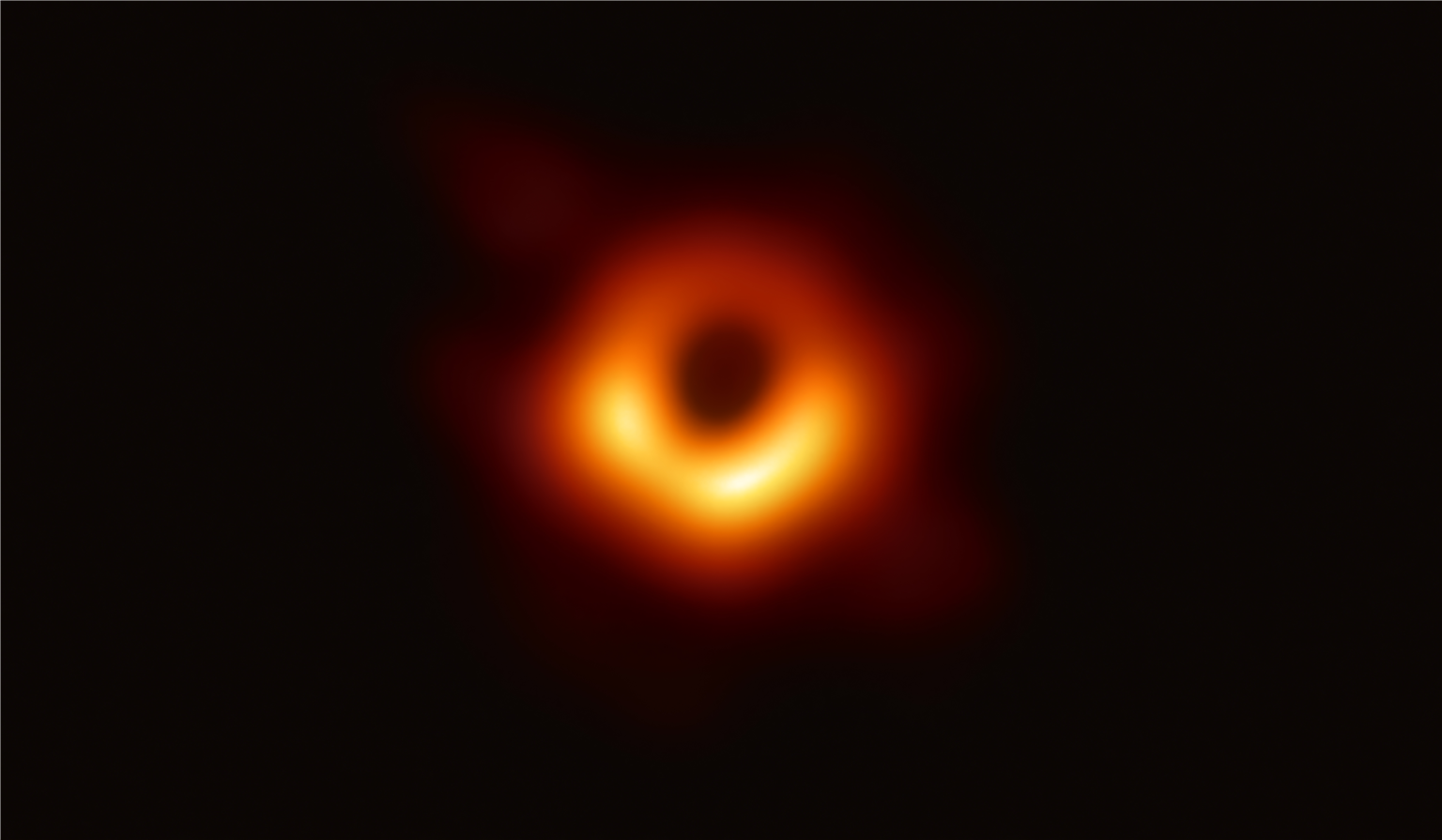
The Event Horizon Telescope — a planet-sized virtual array of radio telescopes — produced the first image of a black hole’s shadow in M87 in April 2019, and of Sagittarius A* in May 2022. What is imaged is not the black hole but the photon ring around it: light bent into a ring by the horizon’s gravity, with a dark silhouette in the middle.
That dark centre is the prediction confirmed. The shadow’s size matched general relativity’s expectation within measurement error.
Frequently asked questions about black holes
Can a black hole swallow the universe?
No. Growth requires mass, and the nearest material is often very far away. Supermassive black holes grow by accretion and mergers, both limited by how much matter reaches them. Their influence is gravitationally significant only extremely close in — the Milky Way’s central black hole affects nearby stellar orbits and essentially nothing at Earth’s distance.
What would happen if you fell into one?
It depends on the mass. A stellar-mass black hole would spaghettify you before you crossed the horizon. A supermassive one would let you cross without local sensation, with the true fate determined by the unknown physics at the centre. Communication with the outside becomes impossible either way once past the horizon.
Could wormholes exist inside them?
General relativity permits solutions resembling wormholes, but they require matter with negative energy density that has never been observed, and the most plausible versions would collapse before anything traversed them. It is a valid mathematical possibility without evidence behind it — a distinction worth maintaining.
Do black holes have a lifespan?
Hawking radiation implies yes, but for any astrophysical black hole the timescale is so enormous as to be meaningless cosmologically. The universe is roughly 1.4 × 10¹⁰ years old; a stellar black hole’s evaporation time is around 1067 years. They outlast galaxies by an absurd margin.
If nothing escapes, how do we see them?
You never see the black hole. You see its surroundings: the heated accretion disk, the X-rays from infalling matter, the gravitational lensing of background light, the orbits of nearby stars, and the distortion of gravitational waves. Every detection method measures something the black hole does to its environment rather than the object itself.
This article explains general physics concepts. For how light behaves in ordinary conditions, see our explainer on why the sky is blue.
Image credit: Event Horizon Telescope Collaboration, "Black hole – Messier 87", CC BY 4.0, via Wikimedia Commons