










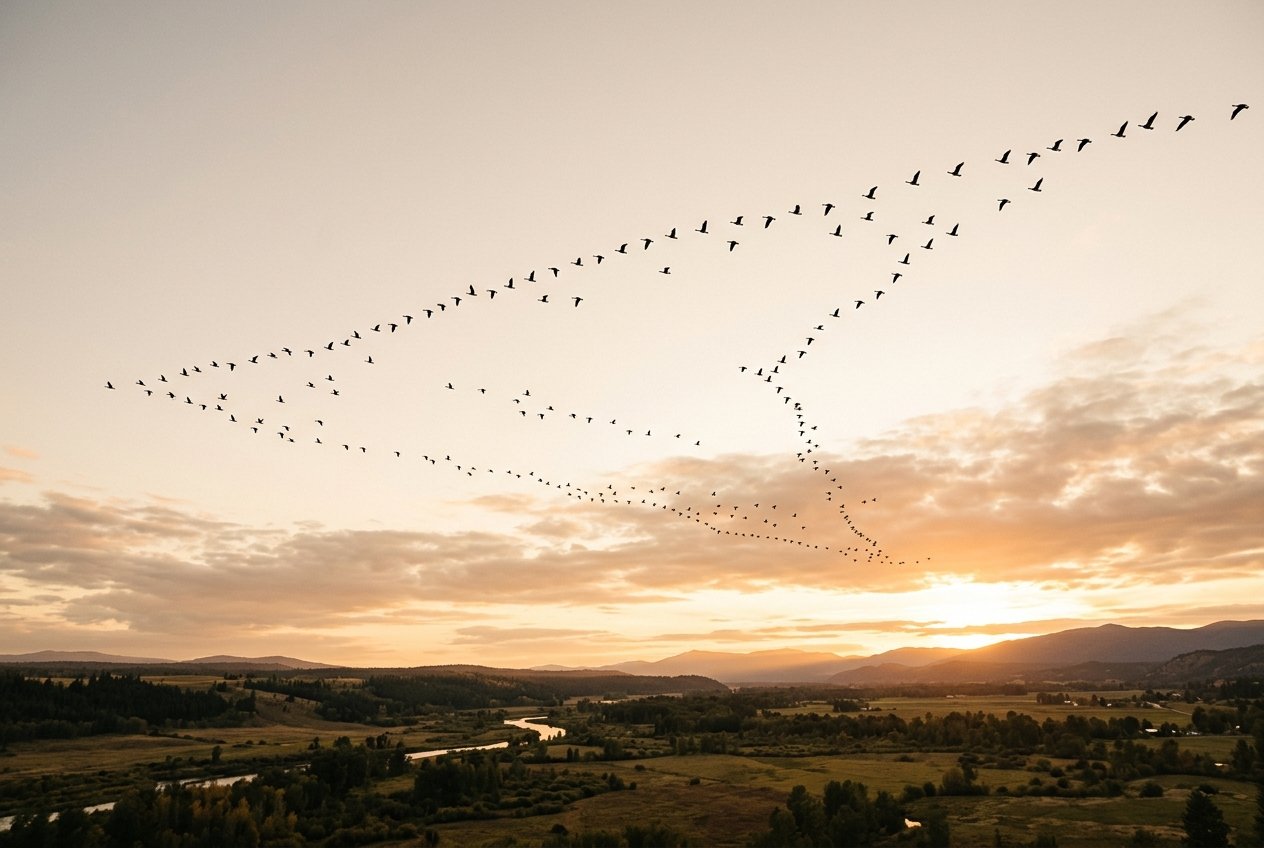
Bird migration is the seasonal, largely predictable movement of birds between breeding and wintering grounds — one of the most extraordinary regular events in biology, performed by creatures that weigh less than a smartphone and navigate without a map.
A bar-tailed godwit departs Alaska and flies roughly 11,000 kilometres to New Zealand without landing, without eating, and without drinking, for eight to eleven days. It does this by shrinking its internal organs before departure and doubling its body fat. Nothing about the mechanics of that journey is casual.
Not all migration looks the same
- Long-distance — Arctic tern, roughly 70,000–90,000 km annually between the poles; barn swallow from Europe to sub-Saharan Africa
- Partial — only part of the population migrates; some individuals of the same species stay year-round
- Irruptive — driven by food rather than season. Northern finches and raptors move south in years when the seed or prey crop fails
- Altitudinal — up mountain slopes in summer, down in winter; short distance, often underappreciated
- Nocturnal vs diurnal — most songbirds migrate at night; raptors soar on thermals by day and cannot fly in the dark
Getting ready
Migration is prepared for physiologically, not merely decided upon:
- Hyperphagia — intensive feeding, in which some species double their body weight
- Fat becomes fuel — fat is the densest energy source available, and migratory birds metabolise it at remarkable rates
- Organ remodelling — the digestive tract shrinks (it is heavy and not needed en route), the heart and flight muscles enlarge. On arrival the organs rebuild
- Zugunruhe — migratory restlessness observable in caged birds, an internal state building before departure
- Timing — governed by photoperiod (day length) triggering hormonal change, with departure and fuelling calibrated to arrive when conditions are best
How they navigate
This is the genuinely remarkable part. Inexperienced birds of many species set off on the correct heading having never made the journey — implying an inherited direction. What they use is a multi-layered compass system, with redundancy built in:
Sun compass
Birds track the sun’s arc and compensate for its movement across the sky using an internal circadian clock. The classic demonstration: shift a bird’s clock artificially and its orientation shifts correspondingly — it is navigating relative to a remembered sun position, not a fixed direction.
Star compass
Star patterns rotate around a fixed celestial pole, and birds learn which point is stationary. Planetarium experiments famously showed that indigo buntings raised under a sky with an artificially rotating centre learned the wrong reference — and then oriented incorrectly in the wild. The rotation pattern is what matters, not any individual star.
Magnetic sense
Birds detect Earth’s magnetic field. Two mechanisms appear to operate: a light-dependent radical-pair mechanism involving cryptochrome proteins in the eye, giving an inclination-based compass; and a magnetite-based receptor in the upper beak, connected to the trigeminal nerve, thought to provide intensity information usable as a map. Disrupting either with magnets or radiofrequency fields impairs orientation.
Olfaction
A sense long assumed absent in navigation. Seabirds — shearwaters and albatrosses — appear to navigate using odour gradients across the ocean, and homing pigeons use smelled landscape as well as vision.
Landmarks, coasts and infrasound
Rivers, coastlines and mountain ranges provide visual reference on familiar routes. Low-frequency infrasound generated by ocean waves and topography has been proposed as a long-range cue, and remains an active area of study.
No single system explains migration. In practice, multiple cues are used simultaneously, and birds fall back on alternatives when one is unreliable — which is why displacing a bird far from home usually results in it getting most of the way back despite having never been there.
The world’s flyways
Migration corridors are organised into recognised flyways, several under the Convention on Migratory Species and the African–Eurasian Migratory Waterbird Agreement:
- Central Asian Flyway — passing through India, with over 200 migratory bird species visiting the subcontinent each winter, arriving from Siberia and Central Asia
- East Asian–Australasian — shorebirds depending critically on the Yellow Sea mudflats
- African–Eurasian — Europe to sub-Saharan Africa, crossing the Mediterranean and Sahara
- Mississippi, Atlantic, Pacific and Central — the Americas
Stopovers are where migrations succeed or fail
A long-distance migrant is only as good as its refuelling sites. These are few, specific, and heavily used: Delaware Bay, where red knots time their arrival to horseshoe crab eggs; the Yellow Sea, where Spoon-billed Sandpipers and other shorebirds rest between Arctic breeding and southern winter; the Wadden Sea.
The vulnerability is obvious — if a single critical mudflat is reclaimed for development, every species routed through it suffers simultaneously. Conservation along flyways is therefore about protecting a handful of specific sites rather than vast areas, which makes it both tractable and urgent.
In India, this means wetlands like Keoladeo at Bharatpur, Chilika Lake and Wular are internationally significant infrastructure for birds they do not even breed in.
Migration is changing
Climate and phenological mismatch
Timing that evolved over millennia is now misaligned. If spring arrives earlier, caterpillar abundance peaks sooner, but birds still departing on day length arrive at the same date — and their chicks hatch after the food has peaked. The great tit and oak caterpillar mismatch in Europe is one of the best-documented cases. Where mismatch grows, breeding success falls.
Range shifts and short-stopping
Many species are wintering further north than previously, compressing or abandoning parts of their route. Some populations that formerly migrated have become resident. Short-stopping — stopping short of the traditional endpoint — is increasingly recorded in Europe.
Barriers and hazards
- Habitat loss at breeding, wintering and stopover sites simultaneously
- Light pollution — nocturnal migrants are drawn to illuminated buildings and collide. Lights-out campaigns during peak migration produce measurable reductions
- Windows and buildings — up to around a billion birds annually in the United States alone
- Cats — a far larger cause of mortality than most people expect
- Wind turbines — a real but comparatively smaller source, with siting and operational mitigations available
- Power lines, communication towers, and severe weather events en route
The effect is not evenly distributed: long-distance migrants that depend on specific habitats at multiple points along a single corridor have declined substantially more than resident species — a pattern described as the “aerial migrants’ squeeze”.
What works
- Protecting critical stopover sites — the highest leverage, because the network is only as strong as its weakest link
- International agreements — migratory birds cross borders by definition, so flyway-level frameworks (CMS, AEWA, EAAFP, Ramsar) are structurally necessary
- Reducing collision risk — bird-safe glass, marking lines on turbines, and shutting lights during peak passage
- Managing predation, particularly by introduced species on breeding islands and shores
- Wetland protection — the single habitat type with the greatest migratory importance
Frequently asked questions about bird migration
How do young birds know where to go?
In most species, the direction is inherited — an internal compass setting rather than a learned route. Cross-fostering experiments show that a bird raised by parents of a different species still heads toward the genetically specified destination. Route detail, stopover knowledge and refinement come with experience, which is why first-year migrants have lower survival than experienced adults. Some species, notably geese, do learn routes socially from their parents.
Do birds sleep while migrating?
Some do, briefly. Research on frigatebirds showed that migrating birds sleep in short unihemispheric bursts — half the brain resting while the other maintains flight control — though total sleep falls substantially during migration. Others rest at stopover sites. The long-distance non-stop fliers largely do not sleep conventionally for the duration of the crossing.
What happens if you move a bird far off course?
It usually gets back. Displaced birds generally reorient toward their normal destination using the compass systems above, even in unfamiliar territory — which is strong evidence that at least part of the direction is inherited rather than memorised. Success depends on distance and habitat; a bird dropped in a desert may not survive long enough to demonstrate the navigation.
Why do some birds stop migrating?
Milder winters and reliable artificial food sources. Urban feeding, agriculture and warming have allowed several species to overwinter further north than historical ranges. The trade-off is real: resident birds avoid the dangerous journey but face higher winter mortality, competition and parasite load. Whether a population shifts depends on that balance.
Is migration getting harder?
For long-distance specialists, yes — consistently. Habitat loss at stopovers, mismatch with food timing, and increased mortality from buildings and cats compound. Resident and short-distance species have generally fared better, which is exactly the differential decline the data shows. What has not changed is that the systems are still functioning; the pressure is on the specific sites and timings that cannot be substituted.
This article explains general nature and science concepts. For related coverage, see our pieces on endangered animals in India and the nature and environment hub.