










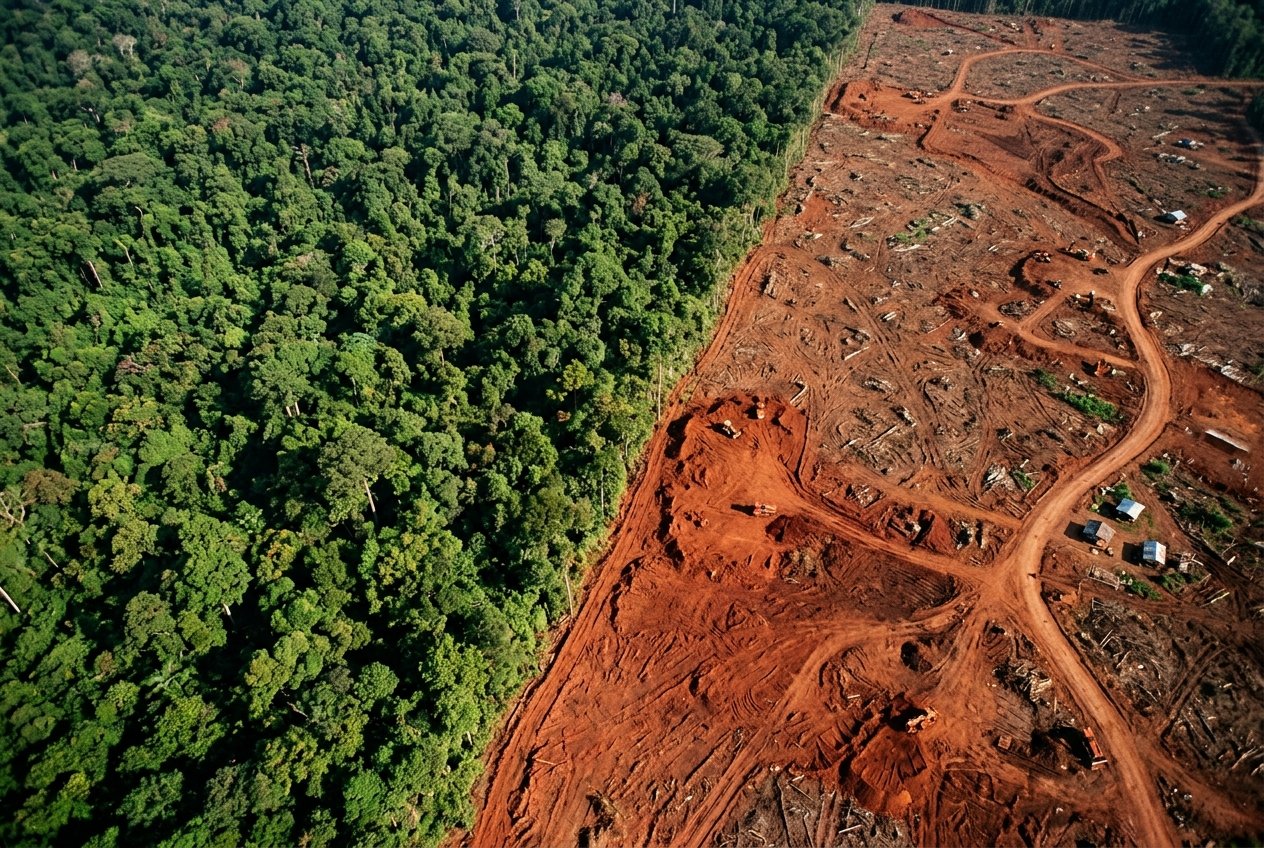
Deforestation is the permanent conversion of forest land to other uses — agriculture, pasture, settlements, infrastructure. Selective logging that leaves the forest standing and able to regenerate is not deforestation; clearing it and planting something else is. That distinction matters, because the word is often used both ways, which muddies the numbers.
Roughly ten million hectares are cleared each year — an area larger than Iceland. The causes are concentrated rather than diffuse: a small number of commodity crops and one industry account for most of it.
What is actually driving it
Agriculture — around 80% of the total
- Cattle ranching — the single largest driver globally, and dominant in the Amazon. It is worth being precise: much of the cleared land is pasture of low productivity, meaning expansion rather than intensification is doing the damage
- Soy — frequently blamed for Amazon clearing, and fairly: but roughly three-quarters of global soy ends up as animal feed rather than direct human food, so it is ultimately a livestock signal
- Palm oil — the dominant driver in Indonesia and Malaysia, on peatland where the carbon cost is disproportionately high
- Cocoa, coffee, rubber, spices — significant regionally, often through smallholder expansion
Logging
Legal and illegal. Selective logging removes valuable trees while leaving canopy structure, but it builds roads — and roads are the reliable predictor of what follows. In the Amazon, roughly 90% of deforestation occurs within 5.5 km of a road. Logging opens access; settlement and clearing arrive behind it.
Infrastructure
Highways, hydroelectric dams, mining, and transmission corridors fragment forest long before they convert it. Fragmentation creates edge habitat, which dries out, burns more readily, and degrades the interior forest around it.
Fire
In humid tropical forest, fire is overwhelmingly deliberate — slash-and-burn land preparation — rather than natural. Intact rainforest does not burn readily; it is made flammable by logging and fragmentation first. Fire then escapes, and the degraded forest burns again the following year.
Governance
Unclear land tenure, weak enforcement, subsidies that favour clearing, and demand in distant countries all contribute. Commodity-driven deforestation is fundamentally a trade and enforcement problem, not a forestry one.
The effects
Carbon and climate
Forests hold on the order of 860 billion tonnes of carbon in biomass, litter and soil. Clearing and burning release it: land-use change contributes several billion tonnes of CO2 annually — around a tenth of global emissions. Critically, the carbon debt from clearing is not repaid by regrowth within a timeframe that matters for climate targets; secondary forest recovers carbon but not the centuries of stored soil carbon and not the original biodiversity.
The mechanism connecting forest to atmosphere begins in the leaf: photosynthesis is the process that drew that carbon down in the first place.
The water cycle
Forests generate rainfall as well as receive it. Through evapotranspiration, the Amazon releases enough moisture to create its own downwind precipitation — so-called “flying rivers” — which supplies rainfall deep into the continent. Models and observations indicate that large-scale clearing would lengthen the dry season and reduce rainfall well beyond the cleared area. Roughly half the Amazon’s rainfall is recycled locally.
Additional effects: increased surface runoff, soil erosion, river sedimentation, degraded water quality, and higher downstream flood peaks.
Biodiversity
Forests contain around 80% of terrestrial species. The losses are not proportional to area: clearing the edge of a forest removes the specialist interior species, and fragmenting what remains isolates populations too small to remain viable. Species that would have survived in a continuous forest can be functionally extinct in fragments — an effect called extinction debt, where the losses come due decades after the habitat was lost.
For how this plays out in specific populations, see our piece on disappearing snakes and the biodiversity crisis.
People
Around 1.6 billion people depend directly on forests for food, fuel, medicine and livelihoods. Indigenous territories cover a substantial share of remaining forest, and where land rights are secure, deforestation rates are consistently lower — often lower than in adjacent formally protected areas.
Health
Forest fragmentation increases human contact with wildlife at the forest edge, which raises the probability of zoonotic spillover. Seasonal smoke haze from fires in Southeast Asia causes documented respiratory harm across entire regions. Fuel and food insecurity follow clearing in many communities.
The tipping point question
Research on the Amazon suggests that somewhere around 20–25% cumulative deforestation, combined with warming and drying, the system could cross a threshold beyond which forest cannot sustain itself and transitions toward savanna-like conditions. Current deforestation is in that vicinity, which is why the question is treated as a live risk rather than a distant theoretical one.
Once crossed, a tipping point does not reverse when deforestation stops — the feedback between forest, moisture and rainfall that maintained the system has already broken.
What actually works
Secure land tenure
Unusually cost-effective. Where communities hold legal title to their forest, clearing falls sharply — because someone with a documented stake objects. This is a governance intervention, not an environmental one, and it is consistently among the highest-value options available.
Enforcement that is funded and sustained
Brazil’s coordinated enforcement programme from 2004 onward cut Amazon deforestation by roughly 80% in five years through monitoring, fines, embargoes and interdiction — demonstrating that rapid reductions are achievable when enforcement is real. The subsequent decline in enforcement effort reversed those gains, which demonstrates the second half of the lesson: results require continuity.
Supply chain transparency
Satellite monitoring now makes clearing visible within days. Global Forest Watch, MapBiomas and national alert systems give buyers and regulators the ability to detect deforestation in a supplier’s catchment. The EU Deforestation Regulation extends this by requiring companies to demonstrate products entering the EU were not produced on land deforested after a cut-off date.
The honest caveat: commitments have repeatedly outperformed on paper and underperformed on the ground, because attribution — proving this soy came from that cleared plot — remains difficult, and enforcement of the requirements lags their announcement.
Protected areas and indigenous territories
Both work. Designation alone does not — a park without funding and enforcement is a line on a map. Where they are resourced, they are effective, and indigenous-managed territory has repeatedly shown the strongest per-hectare performance.
Restoration
Natural regeneration — allowing secondary forest to return on abandoned or degraded land — is far cheaper and typically more biodiverse than planting. Planting has its place where the forest cannot return unaided, but monoculture plantations of eucalyptus or acacia are not forests: they hold little biodiversity, consume water, and should not be counted toward forest restoration targets. The distinction between reforestation and afforestation, and between native restoration and timber plantation, matters a great deal in the reported figures.
Intensification on existing land
Raising productivity on land already cleared is the arithmetic that removes the pressure to clear more — provided the gains are not simply reinvested in expansion, which is what has historically happened in several frontiers.
What an individual can reasonably do
Not much about the direct drivers is controllable from a shopping basket, and overstating individual consumer action tends to obscure the structural causes. But the levers are not mysterious:
- Beef and leather are the strongest personal link to tropical clearing for most consumers
- Choose certified palm oil and soy where certification is credible — RSPO and FSC are imperfect but meaningfully better than nothing
- Reduce food waste; a substantial share of commodity-driven clearing ultimately feeds waste
- Support organisations doing land-rights and enforcement work, where the leverage per rupee is considerably higher than individual purchasing decisions
Frequently asked questions about deforestation
Is planting trees the solution?
Only sometimes, and often it is not what is needed. The higher-value actions are protecting existing forest, securing land rights, enforcing existing law, and letting degraded land regenerate. Tree planting scores well photographically and poorly ecologically when it means monocultures on land that was never forest, or plantations replacing grasslands. Restoration targets are better measured in hectares of native forest recovering than seedlings planted.
Does cutting down one tree matter?
An individual tree does not, and managed forestry is a legitimate, renewable use. The problem is aggregate conversion of forest ecosystem to non-forest. Selective logging under a management plan that maintains canopy and regenerates is a different activity from clear-felling followed by pasture, even though both remove trees.
Do forests absorb enough carbon to cancel emissions?
No. Forests absorb around a quarter to a third of anthropogenic CO2 emissions currently, and that sink weakens as forests are cleared, fragmented, burned and warmed — with some evidence that parts of the Amazon have already shifted from net sink to net source in dry years. Counting on forests to offset continued emissions assumes a sink that is itself being degraded.
Is deforestation still increasing?
It varies sharply by region and by year. Global net loss has slowed relative to the 1990s, but gross clearing in several tropical frontiers has at times re-accelerated — the pattern is driven by policy and enforcement changes as much as by economics. Rates have fallen substantially where enforcement was restored and risen where it was weakened, which is the clearest available evidence that the trend is politically controllable.
What about the jobs lost by stopping deforestation?
This is the legitimate counter-argument and it deserves a serious answer. Enforcement without alternatives produces displacement rather than resolution. What has worked combines enforcement with livelihoods — payments for ecosystem services, agroforestry, sustainable forestry, tourism, and secure land title that gives communities an economic stake in the standing forest. Command and control alone tends to fail or to be reversed at the next change of government.
This article explains general environmental concepts. For related coverage see our nature and environment articles.