









Ashwagandha (Withania somnifera) is one of the most studied plants in Ayurveda and one of the most over-claimed supplements on the internet. Both statements can be true at once.
The honest summary: there is reasonable evidence for a modest effect on stress, cortisol and sleep. There is much weaker evidence for most of what it is marketed for, and there are specific groups who should not take it at all.
What it is
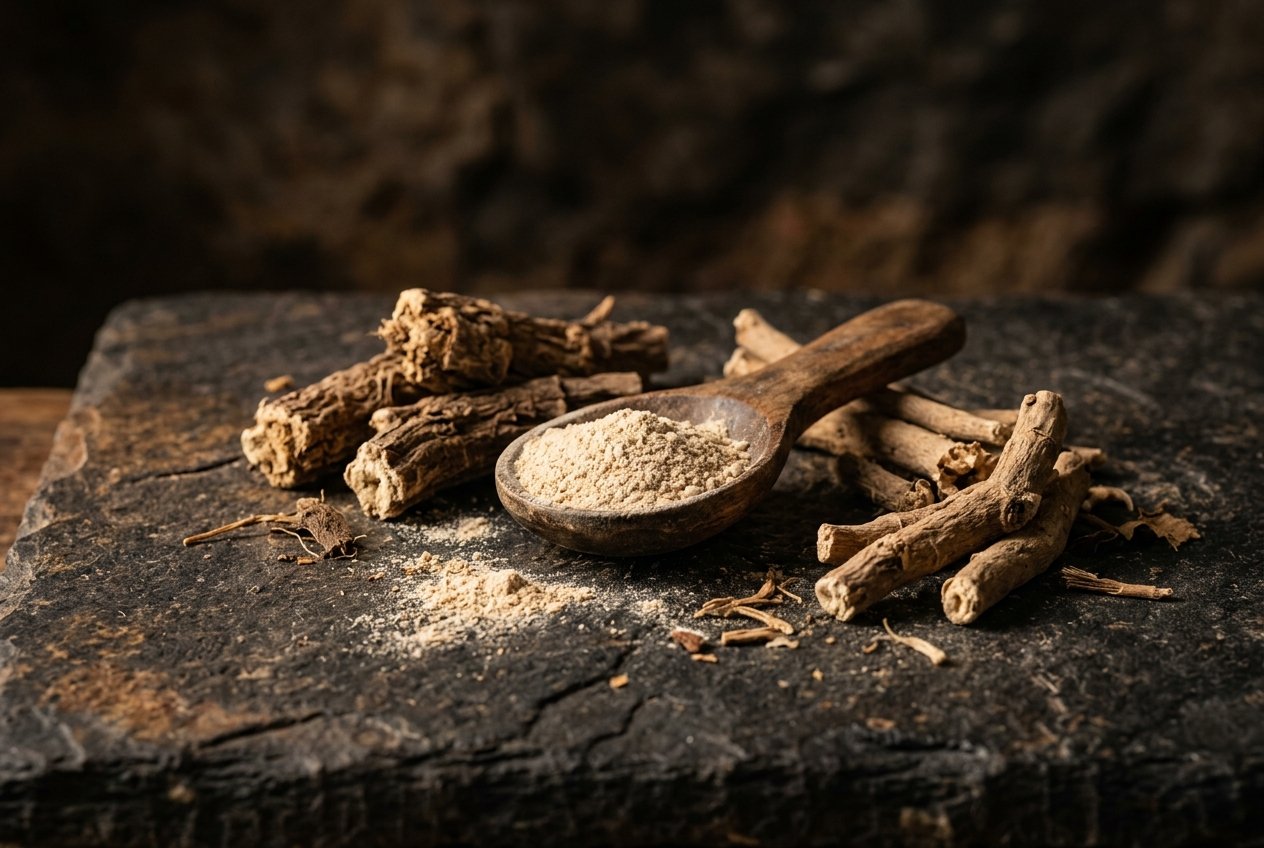
A small shrub of the nightshade family, native to India and North Africa. The root is the part traditionally used, and it contains a class of compounds called withanolides — steroidal lactones believed to account for much of its biological activity.
It is classified as an adaptogen, a term meaning a substance proposed to help the body resist physiological stress. It is worth noting that “adaptogen” is a descriptive category rather than a pharmacological mechanism with a settled definition.
In India it is sold as an Ayurvedic medicine and as a nutraceutical. In the United States it is sold as a dietary supplement and is not FDA-approved for any medical condition — a distinction that matters when reading marketing claims.
What the research supports
Stress and perceived anxiety — the strongest case
Multiple randomised controlled trials and meta-analyses report reduced perceived stress and reduced serum cortisol. A frequently cited trial of 600 mg daily over 60 days found cortisol reductions of roughly 23–30% in the ashwagandha group against about 5% in placebo. Effects on anxiety scales have generally been modest but consistent.
Characterisation: real, directionally consistent, but based on trials that are mostly small, short (8–12 weeks) and often single-centre.
Sleep
Trials have shown improvements in sleep quality, sleep onset latency and morning alertness. The mechanism appears distinct from sedation — it does not work like a sleeping tablet — which is part of why it is often better tolerated.
Cortisol
The most reproducible biomarker finding. Whether a cortisol reduction translates into a meaningful health outcome for someone without a stress-related condition is a separate and less settled question.
Strength and exercise performance
Some trials in young adults report modest improvements in strength, muscle recovery and VO2 max. Effect sizes are small and the literature is heterogeneous — plausible as an adjunct, not compelling as a performance supplement.
Male fertility
Small trials in infertile men have reported improvements in sperm parameters and modest testosterone increases. Study quality and sample sizes limit confidence, but the direction of evidence is reasonably consistent.
Metabolic markers
Modest reductions in fasting glucose and HbA1c have been reported in some trials. Relevant primarily as a potential interaction with diabetes medication rather than as a treatment.
Thyroid
Some evidence of increased T3 and T4 in subclinical hypothyroidism. This cuts both ways — it is a rationale for interest and a serious caution for anyone on thyroid medication.
What is not well supported
- Treatment or prevention of cancer — no clinical basis for this claim
- COVID-19 prevention or treatment — widely promoted, not established
- Broadly “boosting immunity” — the phrase is close to unfalsifiable and should be treated as marketing
- Dramatic testosterone increases in healthy young men — the observed effects are far smaller than supplement marketing implies
- Cognitive enhancement in healthy adults — some positive small trials, insufficient evidence for a confident claim
The evidence problems worth knowing
- Heterogeneous products. Studies used different extracts — KSM-66 (root only, typically ~5% withanolides), Sensoril (root and leaf, higher withanolide content), Shoden (very high withanolide percentage), and plain root powder. Results are not automatically transferable between them
- Small and short. Most trials run 8–12 weeks with tens of participants, not thousands
- Industry funding is common in supplement research
- Publication bias — positive results are more likely to be published
- Population specificity — much of the literature comes from studies in stressed but otherwise healthy adults, or specific clinical groups. It does not follow that benefits apply to everyone
This does not mean it does nothing. It means the effect is probably modest, most reliable for stress and sleep, and less certain than the packaging suggests.
Dosage and format
| Format | Typical amount | Notes |
|---|---|---|
| Standardised root extract | 300–600 mg/day | The range used in most trials; often split as 300 mg twice daily |
| KSM-66 | ~600 mg/day | Root-only extract, the most studied proprietary form |
| Sensoril | 125–250 mg/day | Higher withanolide concentration, so a lower milligram dose |
| Raw root powder | 1–6 g/day | Traditional form; less standardised, content harder to predict |
Practical points: take with food to reduce the chance of stomach upset; morning or evening is acceptable, with evening often chosen where sleep is the target. Allow 8–12 weeks before judging whether it does anything for you — stress and sleep effects rarely appear in the first fortnight. There is no strong evidence that cycling is necessary, though some people choose to.
Safety — the part that gets omitted
Who should avoid it entirely
- Pregnancy — do not take it. It has traditionally been used in Ayurveda for uterine conditions and as an abortifacient. There is insufficient safety data, and the traditional use points the wrong way. This is a firm contraindication
- Breastfeeding — insufficient safety data; avoid
- Autoimmune conditions (rheumatoid arthritis, lupus, multiple sclerosis, type 1 diabetes) — it may stimulate immune activity, which is theoretically undesirable when immune function is already pathologically overactive
Who should use medical supervision
- Thyroid disease — it may increase thyroid hormone levels. Anyone on levothyroxine or antithyroid medication needs monitoring; there are reports of it precipitating thyrotoxicosis
- Diabetes or hypoglycaemia — additive blood-sugar-lowering effect with medication
- Low blood pressure or antihypertensive medication — additive effect
- On sedatives or benzodiazepines — additive drowsiness
- On immunosuppressants — theoretical opposition to the drug’s effect
- Bleeding disorders or anticoagulants — theoretical interaction
- Hormone-sensitive conditions — it can affect thyroid and androgen pathways
Liver injury
Rare but documented. Cases of drug-induced liver injury associated with ashwagandha have been published, including severe presentations. Stop and seek medical attention if you develop jaundice, dark urine, pale stools, right upper abdominal pain, or unusual fatigue while taking it.
Common side effects
Gastrointestinal upset, drowsiness, headache and, less commonly, skin reaction. In trials these are generally mild and comparable to placebo.
A real concern with Ayurvedic products
Studies of Ayurvedic preparations have repeatedly found contamination with lead, mercury and arsenic, particularly in bhasma and some traditional preparations. This is not a theoretical risk and it is not limited to products from one source.
Practical safeguards: choose products with third-party or batch testing for heavy metals and contaminants, buy from manufacturers who publish certificates of analysis, and be wary of products making dramatic claims. “Natural” describes an origin, not a purity standard.
Common misconceptions
- “It works immediately.” No — stress and sleep outcomes in trials emerge over weeks
- “It’s a natural sedative.” It is not a sedative-hypnotic and does not act like one
- “Because it’s a herb, it’s safe.” Herb describes a plant, not a safety profile. It has contraindications, interactions and documented organ toxicity
- “It’s an aphrodisiac.” The evidence is modest, indirect and mostly in specific clinical populations
- “More is better.” Doses above the studied range add cost and risk, not proven benefit
Who might reasonably consider it
An otherwise healthy adult with significant perceived stress or poor sleep who wants to try something with a plausible evidence base, after checking interactions with their medications and any condition they have — and who treats it as a supplement to the fundamentals rather than a replacement for them.
Those fundamentals are doing most of the work: regular sleep timing, physical activity, daylight exposure, manageable workload, and treatment for an anxiety or depressive disorder where one exists. No supplement compensates for their absence, and treating a supplement as a substitute for care for a diagnosed condition is the pattern that causes real harm.
Where anxiety or low mood is significant or persistent, that warrants assessment in its own right — see our guides on anxiety signs and causes and insomnia, and then a clinician.
Frequently asked questions
Which form should I buy?
For consistency, a standardised root extract with a stated withanolide percentage from a manufacturer that publishes batch testing. The specific branded extract matters less than knowing what you are taking, how much of the active it contains, and that it is free of contamination. Compare per-dose cost rather than per-bottle cost, since withanolide concentrations vary several-fold between products.
How long before I notice anything?
Stress and sleep effects in the literature typically appear between four and eight weeks, occasionally longer. If after 12 weeks of consistent use at a studied dose you notice nothing, continuing indefinitely is unlikely to change that — the rational response is to stop rather than increase the dose.
Can I take it with my current medication?
Not without checking. The interactions that matter most are thyroid medication, diabetes medication, blood pressure drugs, sedatives, immunosuppressants and anticoagulants. Even where a supplement is available without prescription, the interaction does not require one — a pharmacist can answer this quickly and it is a question worth asking rather than researching.
Is it safe long-term?
Most trials run 8–12 weeks, so long-term safety data is genuinely limited rather than reassuring. The absence of reported problems over longer periods reflects limited study, not demonstrated safety. For ongoing use it is reasonable to take periodic breaks and to reassess whether it is still serving a purpose.
Does it interact with my thyroid test results?
Potentially, yes — and this is worth knowing before a blood test rather than after. If you take ashwagandha and are having thyroid function assessed, tell your clinician, because an observed change in T3 or T4 may be attributable to the supplement rather than to your condition. Do not stop prescribed thyroid medication on your own judgement — that decision belongs with your doctor.
This article is for general information only and is not a substitute for professional medical advice. Supplements can interact with medicines and are not appropriate for everyone. See our medical disclaimer.