









“Breakfast is the most important meal of the day” is one of the most repeated claims in nutrition, and one of the least well supported. The research is messier, more contradictory and more interesting than the slogan suggests.
What survives scrutiny is narrower and more useful: total intake and overall dietary pattern matter far more than timing, and what you eat at breakfast matters far more than whether you eat it.
What the evidence actually shows
Weight loss
Early observational studies consistently found breakfast eaters were leaner, and this was widely reported as causal. Randomised trials tell a different story: when assignment is randomised rather than self-selected, making people eat breakfast does not reliably produce weight loss, and making them skip it does not reliably cause gain.
The reconciling explanation is confounding — people who eat breakfast systematically differ from those who do not in overall diet quality, activity and routine. In one well-known randomised trial, participants assigned to skip breakfast lost no more weight than those assigned to eat it.
Metabolism
The claim that breakfast “kickstarts” your metabolism does not withstand examination. The thermic effect of food depends on total energy intake, not on the clock. There is no meaningful evidence that the same calories consumed at 8am are metabolised differently from the same calories at 11am.
Cognitive performance
The evidence here is considerably stronger in children — particularly for attention and memory, and most pronounced in food-insecure populations where breakfast addresses an actual deficit. In adults, effects are small and inconsistent once caffeine, expectancy and time of day are controlled for. The claim is substantially better supported for schoolchildren than for office workers.
Cardiometabolic risk
Observational data associates regular breakfast with lower cardiovascular risk. Given what happened with weight, treat this with the same caution: breakfast eaters tend to have better overall dietary patterns, and isolating the meal from the pattern is difficult.
Intermittent fasting
Skipping breakfast is the most common way people adopt a restricted eating window. Trials comparing time-restricted eating with ordinary calorie control, with calories matched, generally find no large advantage for the window itself. Any weight benefit appears to come from eating less overall — which restricted eating does make easier for some people.
That is a legitimate reason to use it: not a metabolic magic, but appetite control that happens to suit your routine.
Who benefits from eating breakfast
- Children and adolescents — the strongest case
- People who become ravenous by lunch and then overeat or choose poorly
- People doing physical work or training in the morning
- People with diabetes, where meal regularity and composition have direct glucose consequences — discuss timing with your clinician
- Anyone who wakes early and has a long interval until their next meal
Who does not need it
People who wake up genuinely not hungry, and who then eat well later. Forcing a meal you do not want, purely on the basis of a slogan, adds calories without benefit. If your morning is coffee until noon and you eat a balanced lunch, there is no established problem to solve.
What makes a breakfast good
Composition is where the evidence is clearer than the timing question. Three components do most of the work:
| Component | Why it matters | Practical targets |
|---|---|---|
| Protein | Most satiating macronutrient; supports muscle protein synthesis | Roughly 15–30 g; most breakfasts fall well short |
| Fibre | Slows glucose absorption, sustains satiety | Whole grains, fruit, vegetables, pulses |
| Healthy fat | Slows gastric emptying, adds satiety | Nuts, seeds, curd, egg yolk, oils used sparingly |
What undermines it: refined carbohydrate plus sugar. White bread with jam, sugary breakfast cereal, maida-based pastries and sweetened tea produce a rapid glucose rise followed by a fall — which is precisely the mid-morning slump that people then attribute to needing breakfast at all.
Liquid sugar deserves separate mention. Fruit juice, sweetened lattes and packaged drinks deliver a large sugar load with none of the fibre that slows absorption. The sugar in three oranges is not equivalent to the sugar in the juice of three oranges, because you would not normally drink them.
Indian breakfast ideas
Indian breakfasts have genuine strengths — fermentation, pulses, dairy and vegetable content are common features. The usual issues are portion, added sugar in tea, and deep-frying.
| Breakfast | Approx. protein | Notes |
|---|---|---|
| Moong dal chilla with mint chutney | ~12–15 g | Pulse-based, high protein, quick |
| Egg bhurji (2 eggs) with whole-wheat toast | ~13–16 g | Complete protein, very satiating |
| Idli with sambar | ~8–12 g | Fermented batter aids digestibility; sambar adds pulses |
| Poha with peanuts, curry leaves and vegetables | ~6–9 g | Light and quick; peanuts lift both protein and fat |
| Upma with vegetables | ~6–8 g | Best made with semolina plus vegetables and a protein alongside |
| Dosa with sambar | ~7–10 g | Fermented; portion and oil matter |
| Curd with fruit, nuts and seeds | ~10–14 g | Two-minute option; add nuts for fat and fibre |
| Ragi porridge with milk | ~8–11 g | Good calcium; check added sugar |
| Vegetable thepla with curd | ~7–9 g | Whole wheat with greens built in |
| Sprout chaat with lemon | ~10–13 g | High fibre and protein, minimal oil |
| Oats upma with vegetables | ~7–9 g | Higher fibre than semolina upma |
| Boiled eggs with fruit and nuts | ~12–14 g | No cooking time beyond boiling |
Where Indian breakfasts often go wrong: poori and deep-fried items are an occasional food rather than a daily one; white bread and maida sandwiches replace whole grains; tea carries four spoons of sugar; large portions of sabudana khichdi or poori-chole deliver starch without much protein. Most of these are easily adjusted without abandoning the dish.
Making it actually happen
- Anchor it to something you already do — after the morning routine, before leaving, at the desk on arrival
- Prepare the night before — overnight oats, soaked and ground batter, boiled eggs, cut vegetables, soaked nuts. The barrier is almost never willingness, it is time
- The two-minute rule — if a breakfast cannot be made in two minutes on a weekday, it will not be made. Have a weekday option and a weekend option
- Keep protein visible — eggs, curd, milk, sprouts, roasted chana, nuts. If protein requires cooking at 6am, it will not happen
- Move sugar out of the default — reduce it gradually rather than eliminating tea altogether, which tends not to last
- Check portion, not just composition — an otherwise sound breakfast at twice the needed size is still an overconsumption problem
Claims that do not hold
- “Breakfast must be eaten within minutes of waking.” No physiological basis. Eat when you are hungry
- “Fruit on an empty stomach is harmful.” Not supported. Fruit on an empty stomach is digested perfectly well
- “Eggs raise your cholesterol.” Dietary cholesterol has a modest effect in most people, and recent guidance has moved away from strict caps. Saturated fat and overall dietary pattern matter considerably more. For most healthy adults, eggs as part of a balanced breakfast are not a concern — though individual response varies and clinical advice applies if you have been told otherwise
- “Breakfast cereals are a healthy default.” Many are heavily sugared and finely milled. Read the label: fibre and protein at the top, sugar near the bottom
- “You must eat breakfast to lose weight.” Not supported by randomised evidence. A calorie deficit is what produces weight loss; meal timing is a personal preference around it
Frequently asked questions
Is it bad to skip breakfast every day?
For a healthy adult with an otherwise good diet, no — this is not established as harmful. What matters is what happens across the rest of the day. If skipping leads to a large, poor-quality lunch and afternoon snacking, the pattern is unhelpful even though the mechanism is not the meal itself. If skipping suits you and you eat well later, there is no problem to fix.
Does tea or coffee on an empty stomach harm you?
For most people, moderate caffeine without food is not harmful. If it causes you stomach discomfort, palpitations or jitters, having it with food is a simple adjustment. The bigger variable is usually what goes into the cup — several spoons of sugar daily is a far more consequential habit than the timing of the drink.
How much protein do I need at breakfast?
Around 15–30 g is a reasonable target for satiety and muscle protein synthesis, though total daily intake matters more than its distribution. Most common breakfasts land at 5–8 g — toast, cereal, or plain poha — which is why hunger returns by mid-morning. Adding eggs, curd, milk, pulses or nuts is usually enough to close the gap without changing the meal’s character.
Are oats actually healthy?
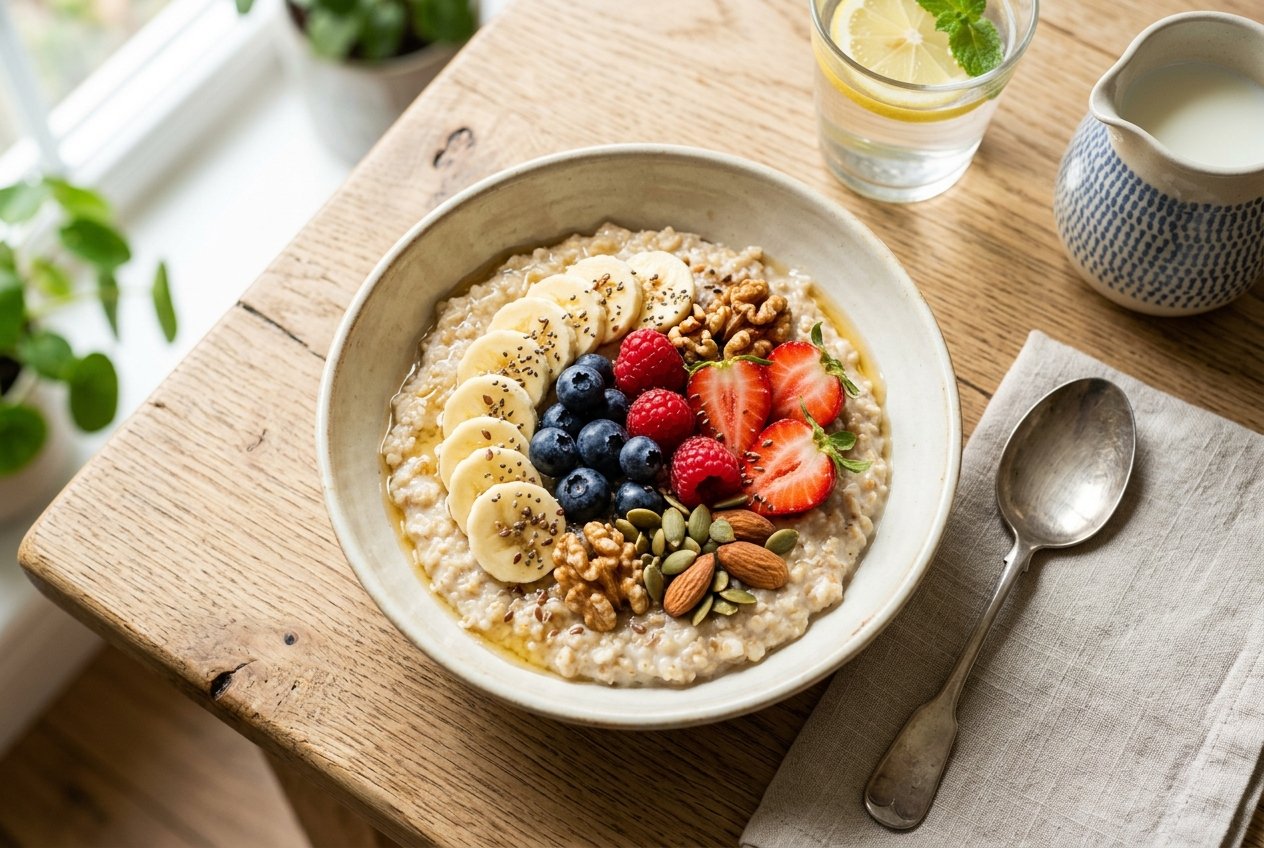
Plain oats are a good choice — high in soluble fibre, including beta-glucan, with reasonable evidence for cholesterol and satiety benefits. The problem is what they arrive with. Flavoured instant oats commonly contain as much sugar as a dessert, and oats drenched in honey and dried fruit are a very different proposition from oats with milk and a pinch of salt. Buy plain oats and control the additions yourself.
Is a heavy breakfast better than a light one?
Some research suggests front-loading intake may suit glucose regulation better than back-loading, and this is a reasonable consideration for people with diabetes — but it does not make a large breakfast beneficial in itself. The practical answer is a breakfast substantial enough to prevent a ravenous, poor-quality lunch, at a size consistent with your total needs. Composition again beats quantity.
This article is for general information only and is not a substitute for dietary advice from a qualified professional, particularly if you have diabetes or another condition affecting diet. For related coverage see our heart-healthy Indian diet guide and guide to removing pesticide residue from produce.