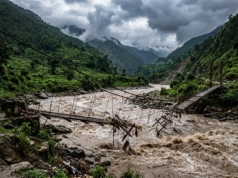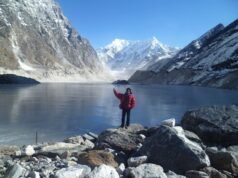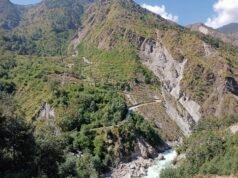
Flash floods in the Himalayan region can arrive with little warning. Some come from glacial lakes that burst their dams, some from landslides that block a river and then give way, and some from heavy rain on steep slopes. Past events in Nepal and northern India show the same pattern: the warning signs were there, and communities were most at risk when those signs were missed or ignored.
This guide sets out what earlier incidents show, the warning signs to look for, and what to do if you live or travel near a river in the mountains. It is based on reporting and official sources, and it does not replace instructions from local authorities.
What past events show
Three recent incidents illustrate different ways the danger arises.
Uttarakhand, June 2013
A cloudburst centred on the Indian state of Uttarakhand in June 2013 caused flooding and landslides. The Associated Press reported on 16 July 2013 that more than 5,700 people who had been missing since the floods were being presumed dead. Uttarakhand’s chief minister said the government had earlier put the death toll at 600, and that the exact number of people who died may never be known. Figures reported later differ, and the Wikipedia summary gives a later death toll of 6,054. Heavy rain for four consecutive days, combined with melting snow, aggravated the floods. Debris blocked rivers, causing major overflow.
The same summary says that warnings from the India Meteorological Department were not given wide publicity beforehand, and that thousands of people were caught unaware.
Tsho Rolpa, Nepal
Tsho Rolpa is one of the largest glacial lakes in Nepal. It lies at 4,580 metres in the Rolwaling Valley, Dolakha District, and has grown considerably over the past 50 years as glaciers melt. The lake threatens to burst through its unstable dam, which would endanger the lives and livestock of more than 6,100 villagers living around the Tamakoshi River.
A Wikipedia summary, citing UNDP reporting from 2012, says an early warning system installed in the late 1990s became defunct through lack of maintenance, and that a more modern system was to replace it. We could not access the UNDP report directly. This shows that warning systems need ongoing funding and upkeep, not just installation.
Bhotekoshi and Trishuli, August 2026
On 26 August 2026, an ice-rock avalanche near the border with China’s Xizang Autonomous Region set off a flash flood that ran down the Lhende, Bhotekoshi and Trishuli river system. The Kathmandu Post reported on 9 October 2026 that at least 269 children affected by the floods in Nuwakot and Rasuwa districts had lost one or both parents, according to a study by the National Child Rights Council. The council said that number could rise, because the documentation was still ongoing.
This event was not a glacial lake outburst flood. It shows that a flood can start from an avalanche rather than a lake, so warning signs should not be limited to lakes.
Budhi Gandaki, October 2026
On Sunday 11 October 2026, a flash flood on the Budhi Gandaki river in Gorkha swept away houses and bridges. The Department of Hydrology and Meteorology’s Flood Forecasting Section said a landslide near Chumchet may have blocked a tributary, which then released its water suddenly. The section said the Trishuli corridor as far downstream as Benighat remains at very high risk. Four people had been reported missing, and no deaths had been confirmed at the time of reporting.
Warning signs to watch for
The incidents above share several signs that people near rivers can watch for:
- Sudden loud sounds from a river, as reported in Gorkha, where residents heard loud sounds from the rivers around 4am before the flood reached them.
- Water levels that rise, fall and rise again, which can mean a natural dam is forming and breaking upstream.
- Recent landslides or avalanches on slopes above a river, especially after heavy rain.
- Muddy or suddenly rising water with debris, which suggests material is being carried downstream.
- Official warnings from the flood forecasting section, police or district authorities, including loudspeaker announcements.
What to do if you are near a river
- Leave riverbanks and low ground as soon as you hear a warning or notice rising water, especially if you hear loud sounds from upstream.
- Move to higher ground that is away from the river and from slopes that have recently slid.
- Do not cross flooded water on foot or in a vehicle. Fast-moving water can be deeper and stronger than it looks.
- Keep informed. Follow the Department of Hydrology and Meteorology and local district authorities, and listen for police or local announcements.
- Check on others who may not have heard a warning, including people in shelters or huts close to the water.
Advice for trekkers and travellers
In the Himalayan region, roads and footbridges can be cut off with little notice. Before setting out, check the latest local conditions with the authorities, and avoid routes along rivers during heavy rain. Keep a plan for reaching higher ground, and tell someone where you are going.
Frequently asked questions
Are all Himalayan floods caused by glacial lakes?
No. Glacial lake outburst floods are one type. The 2026 Bhotekoshi flood started with an ice-rock avalanche, and the Budhi Gandaki flood is linked to a landslide that may have blocked a river.
Why do warnings sometimes fail?
The Uttarakhand 2013 reports say warnings were not given wide publicity, and the Tsho Rolpa early warning system stopped working after it was not maintained. Warnings only protect people if they reach them and the systems behind them are kept working.
How can I tell whether a flood is coming?
Sudden changes in river sound, colour and level are the main signs. Official warnings are the most reliable source, so act on them even if the river looks normal where you are standing.
Sources
- Associated Press, “India raises flood death toll; reaches 5,700 as all missing persons now presumed dead,” 16 July 2013, archived copy on CBS News: cbsnews.com (archived)
- Wikipedia, “2013 North India floods,” for the later death toll of 6,054: en.wikipedia.org
- Wikipedia, “Tsho Rolpa,” citing UNDP reporting from 2012 on the early warning system (UNDP original not accessed): en.wikipedia.org
- Kathmandu Post, “Bhotekoshi floods leave 269 children without one or both parents,” 9 October 2026: kathmandupost.com
- Kathmandu Post, “What we know so far about the damage caused by Budhi Gandaki floods,” 11 October 2026: kathmandupost.com
- Kathmandu Post, “Landslide may have triggered flash flooding in Budhi Gandaki, officials say,” 11 October 2026, citing the Department of Hydrology and Meteorology: kathmandupost.com
This article is general information. Flood conditions change quickly. For current warnings, follow the Department of Hydrology and Meteorology, the National Disaster Risk Reduction and Management Authority, and local district authorities. In an emergency, call the local emergency number and move to higher ground without delay.