










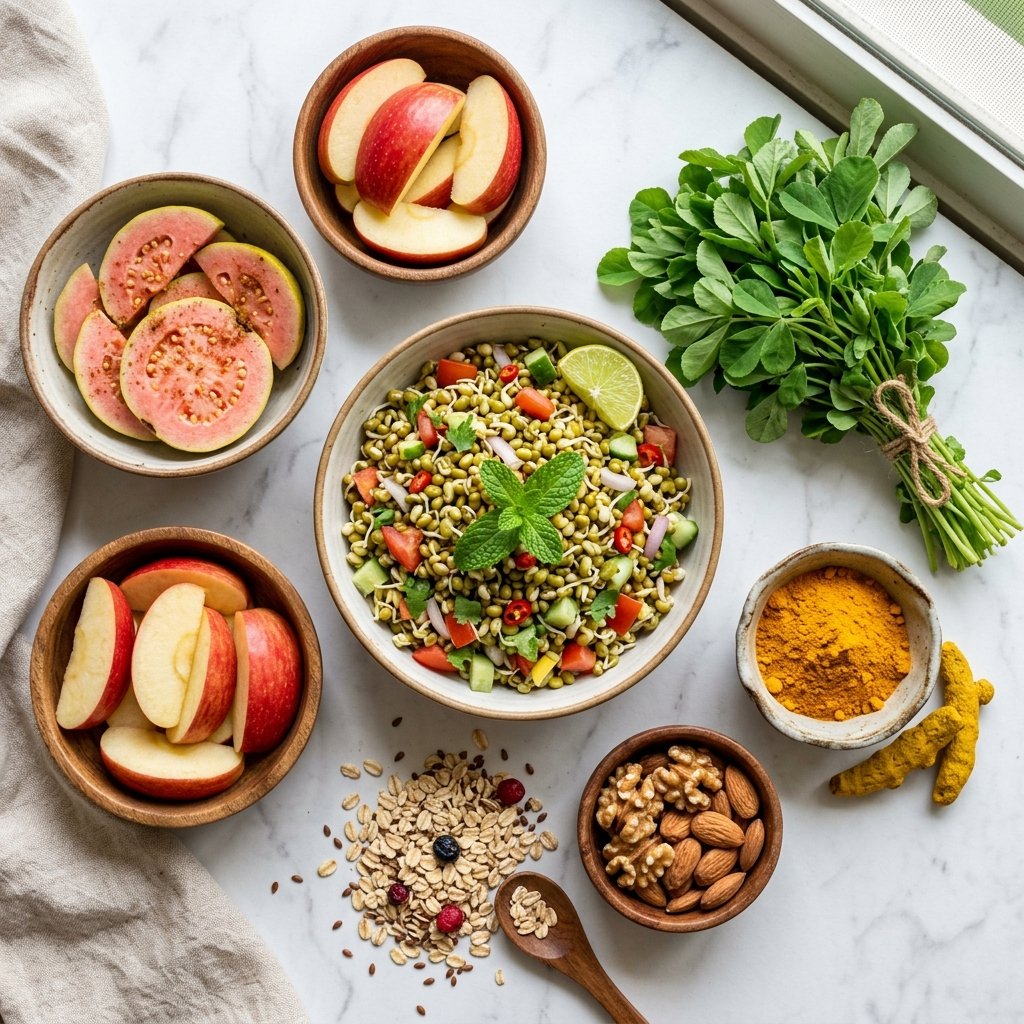
Sodium and high blood pressure are linked more directly than almost any other factor in your kitchen. If you have high blood pressure, sodium is the single most controllable item in your kitchen. The science is unusually clear: the less salt you eat, the lower your blood pressure reads over days, not months. This guide covers how much salt is too much, where the salt is actually hiding in Indian cooking, what the DASH diet really looks like on an Indian plate, and a practical seven-day plan you can follow without giving up food you enjoy.
This is a companion to our complete introduction to high blood pressure and hypertension — read that first if you are new to your numbers.
Sodium and high blood pressure: why the link is so strong
Sodium makes your body hold on to water. More water in your bloodstream means more volume pushing against your artery walls — and that pressure, measured over time, is high blood pressure. On a low-sodium day your kidneys excrete that extra fluid and readings start to fall.
This is why blood pressure responds to salt within days, not years. In the landmark DASH-sodium trial, people with high blood pressure who cut sodium from about 3,400 mg to about 2,300 mg a day lowered their systolic pressure by an average of 6 mmHg, and cutting further to 1,500 mg lowered it by up to 11 mmHg — roughly the effect of a single blood pressure medicine, with no tablets and no side effects.
Not everyone is equally salt-sensitive. People with hypertension, older adults, people of South Asian, African, or East Asian descent, and people with diabetes or kidney problems tend to see the biggest drops. That means the DASH-style approach is especially powerful for most Indian families.
How much salt is too much?
The World Health Organization recommends under 5 grams of salt per day for adults — that is just under one level teaspoon, and it equals about 2,000 mg of sodium. The DASH-sodium study’s lowest level was 1,500 mg of sodium (3.75 g of salt), which some doctors use as a target for people with hypertension, diabetes, or kidney disease.
The uncomfortable truth is that most people eat twice that. A packed thali, a portion of restaurant biryani with raita, or a bowl of instant noodles at night can push a single meal past 5 g of salt. The gap between what we think we eat and what we actually eat is usually the whole problem.
The 1:2.5 rule
Salt and sodium are not the same number. Salt is about 40% sodium, so multiply any sodium figure by 2.5 to get the salt equivalent. A packet that says “920 mg sodium” contains about 2.3 g of salt — about half your whole day’s allowance. Learning this one ratio changes how you read food labels.
The hidden salt in Indian kitchens
You probably don’t add 5 g of salt from your hand. The danger is the salt already inside packaged and restaurant food. The biggest hidden sources in a typical Indian diet:
| Food | Typical salt per serving | What to use instead |
|---|---|---|
| Instant noodles (1 packet) | 2–4 g | Cook with half the tastemaker; squeeze lemon or lime |
| Namkeen, sev, salted peanuts (1 handful) | 1–2 g | Roasted chana, unsalted nuts, fresh puffed makhana |
| Aachar / pickles (1 tsp) | 0.5–1.5 g | Fresh chutney made with coriander, mint, or tamarind |
| Papad (1 piece) | 0.5–1.5 g | Roasted papad once a week, or skip the masala sprinkle |
| Restaurant biryani or kebab (1 plate) | 4–6 g | Home-cooked; use whole spices, not spice masala mixes |
| White bread / pav (2 slices or 1 pav) | 0.8–1.5 g | Whole-wheat roti, jowar, or bajra |
| Soup sachets, stock cubes (1 cube) | 2–4 g | Homemade stock with ginger, garlic, and peppercorns |
| Cheese (25 g processed) | 0.5–1 g | Paneer soaked in water to remove excess salt |
Processed and restaurant food accounts for about 70% of the salt most people eat. Getting home cooking right makes everything else easier.
The DASH diet, desi style
DASH stands for Dietary Approaches to Stop Hypertension, and it is repeatedly ranked among the best diets for blood pressure — partly because it is not a crash diet but a pattern. Its rules are easy to translate to Indian food:
- Fill half your plate with vegetables and fruit every meal — bhindi, palak, lauki, ghiya, carrots, green beans, and seasonal fruit.
- Choose whole grains over refined — roti from whole atta, brown rice, oats, jowar, bajra, ragi.
- One serving of dal, legumes, or tofu/soy per meal for protein and potassium-rich fiber.
- Include fat-free or low-fat dairy — a glass of milk, a bowl of curd, or a portion of paneer.
- Keep nuts, seeds, and healthy fats small — a handful of almonds or walnuts, a spoon of oil per person per meal.
- Go very low on added salt, sweets, red meat, and anything fried.
Understanding sodium and high blood pressure makes the DASH rules obvious. Potassium is the reason DASH works so well. Potassium helps your kidneys flush sodium out, so the diet’s emphasis on bananas, leafy greens, lentils, and fruit matters as much as the salt cut itself. If you have kidney disease, check with your doctor before increasing potassium-rich foods.
A 7-day sodium-smart Indian meal plan
| Day | Breakfast | Lunch | Dinner |
|---|---|---|---|
| Mon | Ragi porridge + mixed nuts, apple | Whole-wheat roti, palak dal, lauki sabji + curd | Vegetable khichdi + cucumber raita, roasted papad (no masala) |
| Tue | Moong dal chilla with mint chutney | Brown rice, rajma, bhindi sabji, green salad | Oats upma + curd, a handful of almonds |
| Wed | Sprouted moong fruit bowl (banana, orange) | Jowar roti, chana masala (home, low salt), ghiya subji | Grilled paneer tikka + tossed vegetables, lime juice |
| Thu | Vegetable poha with peanuts and lemon | Bajra roti, dal palak, cabbage sabji, curd | Vegetable soup (no cube) + whole-wheat chapati |
| Fri | Oats + mashed banana + walnuts | Whole-wheat roti, tori/doodhi sabji, masoor dal | Brown rice + sambar (less salt), cucumber salad |
| Sat | Idli (2) + sambar + coconut chutney (no salt added) | Whole-wheat roti, soya chunk curry, beans sabji | Ragi dosa + mint chutney + vegetable stew |
| Sun | Besan chilla with tomato chutney | Celebration home meal: roti, paneer bhurji, kachumber salad | Fruit salad with curd + dry roasted makhana |
Drink water with meals, keep one or two fruit portions, and use this plan as a template rather than gospel — swap items you already cook and love.
Ten swaps that cut salt without cutting taste
- Season with lemon, lime, raw mango, or tamarind instead of a second pinch of salt.
- Roast and grind your own whole spices — coriander, cumin, fennel, methi — for flavour without the sodium in masala mixes.
- Half the tastemaker packet and finish with lemon — you will barely notice on day two.
- Cook dal and sabji without salt, then sprinkle a tiny pinch on your own plate. Each person gets their own dose.
- Rinse canned beans and store-bought paneer under water before cooking. Rinsing canned beans removes up to 40% of the sodium.
- Use ginger-garlic paste, green chilies, and curry leaves generously. They add heat and aroma, not salt.
- Swap stock cubes for water plus whole spices and a bay leaf.
- Choose “no added salt” atta, oats, and rice — check the packet.
- Snack on puffed makhana, roasted chana, and unsalted nuts instead of namkeen.
- Cook at home on weekdays. Even healthy restaurant dishes hide salt; your kitchen is the one place you control the spoon.
How to read labels: the 2-minute checklist
In India, packaged salt per 100 g can look small until you multiply by your portion. Two quick checks settle almost every label:
- Find sodium (or “sodium salt equivalent”) and divide by 400 to get salt grams per serving — 400 mg sodium ≈ 1 g salt.
- Compare with the 5 g daily target: one 400 mg packet is a fifth of your whole day.
Anything over 1.5 g sodium per 100 g is a high-salt food; under 0.3 g is low. Check the back of noodles, sauces, soups, biscuits, and cheese — not the front of the pack.
Special situations
If you are on blood pressure medicine
A lower-sodium diet can lower readings enough that some people need less medicine — never adjust your own dose. If your blood pressure starts dropping, tell your doctor and let them decide whether medication needs a change.
If you have kidney disease
Sodium matters more, but potassium-rich DASH foods need a doctor’s sign-off, because damaged kidneys can struggle to clear potassium. Work with your nephrologist on both the target and the food list.
Older adults
Salt sensitivity rises with age, but so does the risk of low blood pressure and dizziness. Cut salt gradually and keep monitoring regularly — discuss your personal target, often around 1,500–2,000 mg sodium.
How fast will readings improve?
The beauty of sodium and high blood pressure is that the feedback loop is fast: most people see a meaningful drop in systolic pressure within one to two weeks of a genuine low-sodium diet, with the strongest effect in the first few days. The effect compounds: combined with regular walking, weight management, and the habits in our complete high blood pressure guide, a low-sodium diet is the most effective non-drug treatment there is.
Track your numbers weekly with a good home monitor, log your meals for the first fortnight, and talk to a doctor before making large changes if you take medicine or have kidney problems. And because folate status matters for heart and blood health, see our breakdown of folic acid and red blood cell health too.
Frequently asked questions
Is Himalayan pink salt better for blood pressure?
No. Pink salt is mostly sodium chloride, exactly like table salt, just with trace minerals. A gram of pink salt contains about the same sodium as a gram of white salt, and it counts the same toward your daily limit.
Does cutting salt suddenly cause side effects?
Some people notice a few days of low energy or mild dizziness as their body releases fluid. Drink enough water, keep fruit and dal in the day, and go gradual if it is unpleasant. Severe dizziness or fainting means you should talk to a doctor.
Is sea salt healthier than table salt?
Not in meaningful amounts for blood pressure. Sea salt is still about 40% sodium. The only real advantage of finishing salt is that its larger crystals add flavour with less volume, so you may use slightly less.
Can I reverse high blood pressure by eating less salt alone?
For sodium and high blood pressure the evidence is unusually clear: sodium reduction is the single biggest dietary lever and can bring some people on the elevated or stage-1 level back into range. For many others, salt alone is not enough — combine it with the full plan in the main hypertension guide: exercise, weight, sleep, alcohol, and, if prescribed, medication.
How do I measure my salt at home?
Level measuring spoons work: 1 tsp salt ≈ 5 g ≈ 2,000 mg sodium, about your entire day’s allowance. A pinch from the hand can be 0.3–0.5 g per pinch, which adds up fast — measure for your first two weeks until your hand learns.
Salt substitutes worth knowing
Potassium-based salt substitutes replace some sodium chloride with potassium chloride and taste almost identical. Small trials ? including the large SSaSS study published in the New England Journal of Medicine ? found they lowered stroke risk in people at high cardiovascular risk. They are not for everyone: if you have kidney disease or take certain blood-pressure medicines (ACE inhibitors, ARBs, potassium-sparing diuretics), ask your doctor before switching, because damaged kidneys can struggle to clear potassium. For everyone else, a potassium-based shaker on the table is one of the simplest swaps in the kitchen.
Tracking your progress
Weigh your baseline for two weeks before judging anything: same arm, same time of day, seated after five minutes of rest. Log the average of two readings each morning, along with roughly how much salt the day contained. Patterns show up faster than individual numbers ? and a two-week trend gives you and your doctor far more to work with than any single reading ever will.
One habit that makes all of this stick: cook one meal a week entirely from scratch with measured salt, and taste restaurant food before reaching for the shaker ? you recalibrate your own palate in about a fortnight. Pair that with the weekly weigh-in of your blood pressure log, and the numbers become feedback instead of surprise. Two habits, fifteen minutes of effort, and the entire plan above stops being a diet and starts being normal life.
Sources and references
The numbers and recommendations above come from:
- World Health Organization ? Salt reduction
- Sacks et al., DASH-Sodium Trial, NEJM 2001
- NHLBI ? DASH Eating Plan
- Harvard T.H. Chan School ? Salt and sodium
- 2017 ACC/AHA Hypertension Guideline
This article is for information, not medical advice. Always check changes to your diet and medication with a qualified doctor, especially for hypertension, diabetes, and kidney disease.
Read next on Dangit: acidity home remedies that work fast.
Explore more on Dangit: health, technology, science, nature, featured, lifestyle, society, the local business directory and more reading.






[…] also: Sodium and High Blood Pressure: The 7-Day DASH Diet Guide and High Blood Pressure (Hypertension): The Complete Evidence-Based […]
[…] also: Sodium and High Blood Pressure: The 7-Day DASH Diet Guide and High Blood Pressure (Hypertension): The Complete Evidence-Based […]
[…] also: Sodium and High Blood Pressure: The 7-Day DASH Diet Guide and High Blood Pressure (Hypertension): The Complete Evidence-Based […]
[…] also: Sodium and High Blood Pressure: The 7-Day DASH Diet Guide and High Blood Pressure (Hypertension): The Complete Evidence-Based […]
[…] also: Sodium and High Blood Pressure: The 7-Day DASH Diet Guide and High Blood Pressure (Hypertension): The Complete Evidence-Based […]
[…] also: Sodium and High Blood Pressure: The 7-Day DASH Diet Guide and High Blood Pressure (Hypertension): The Complete Evidence-Based […]
[…] also: Sodium and High Blood Pressure: The 7-Day DASH Diet Guide and High Blood Pressure (Hypertension): The Complete Evidence-Based […]
[…] Sodium and High Blood Pressure Guide […]
[…] Sodium and High Blood Pressure Guide […]
[…] If blood pressure is also in your picture, our evidence-based guide to high blood pressure and DASH diet guide complete the loop. Together these guides give you the same plan your doctor would […]