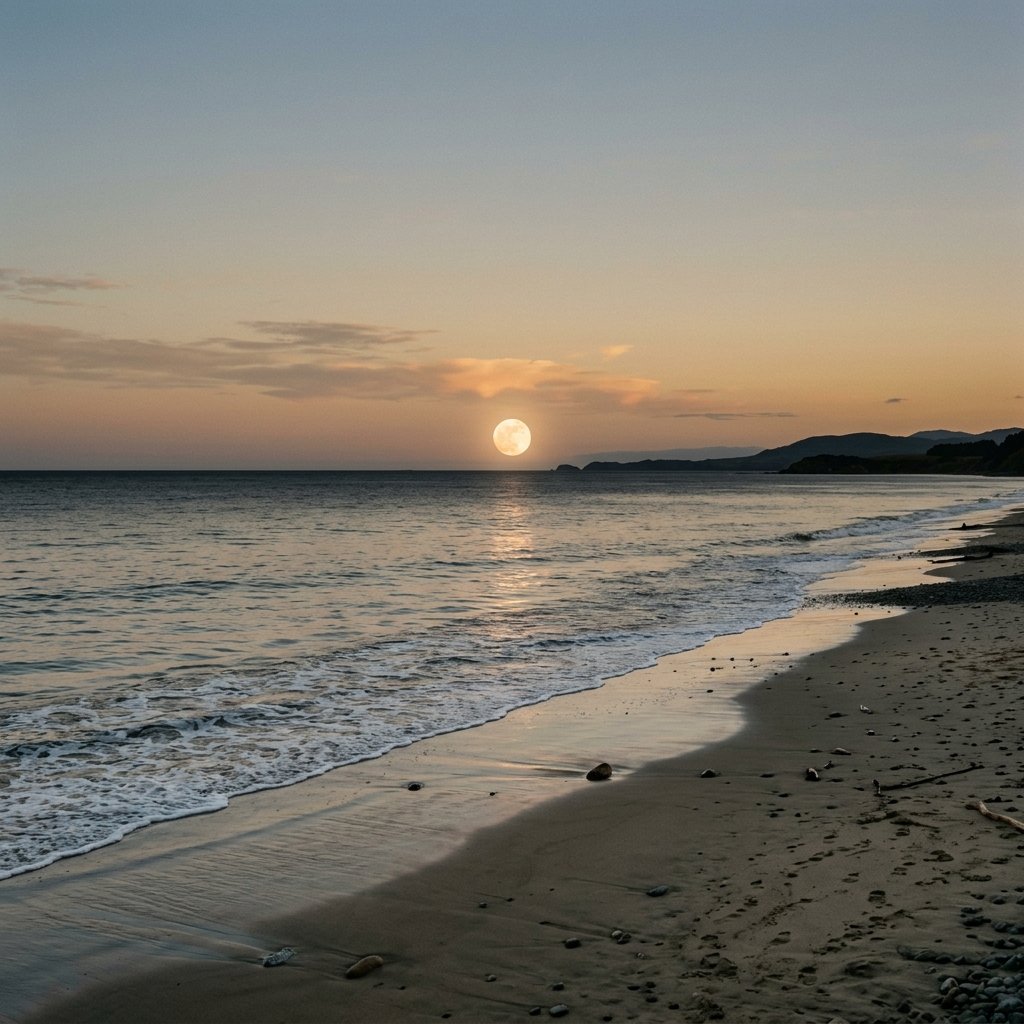
Tides are the regular rise and fall of the sea. Most coasts see two high tides and two low tides roughly every 24 hours and 50 minutes. The cause is gravity, mainly from the Moon, with the Sun playing a smaller role.
The Moon pulls the ocean
The Moon’s gravity pulls on the near side of Earth more strongly than on the far side. This stretches the oceans into two bulges, one facing the Moon and one on the opposite side. As Earth rotates, a coastline passes through each bulge, which produces high tide. Between the bulges, the water level falls, which produces low tide.
The Sun’s role
The Sun is much larger, but it is also much farther away, so its tidal pull is about half that of the Moon. When the Sun and Moon line up, during new and full moon, their pulls combine into stronger spring tides. When they are at right angles, during the quarter moons, their effects partly cancel and produce weaker neap tides.
Why tides differ from place to place
- Shape of the coast: bays and estuaries can amplify the rise.
- Depth of the water: shallow seas often have larger tides.
- Ocean basins: the size and shape of a basin affect how water sloshes back and forth.
Some places have one high tide a day, and some have mixed patterns with uneven highs and lows.
Why it matters
Tides affect shipping, fishing, coastal erosion and the ecology of shorelines and estuaries. They are also a source of renewable energy in some locations, though tidal power is still limited to a few sites.
Frequently asked questions
Why do tides come about 50 minutes later each day?
The Moon moves along its orbit as Earth rotates, so it takes about 50 extra minutes each day for the Moon to return to the same point in the sky.
Do tides happen in lakes?
Lakes have very small tides caused by the same gravity, but they are usually too small to notice.