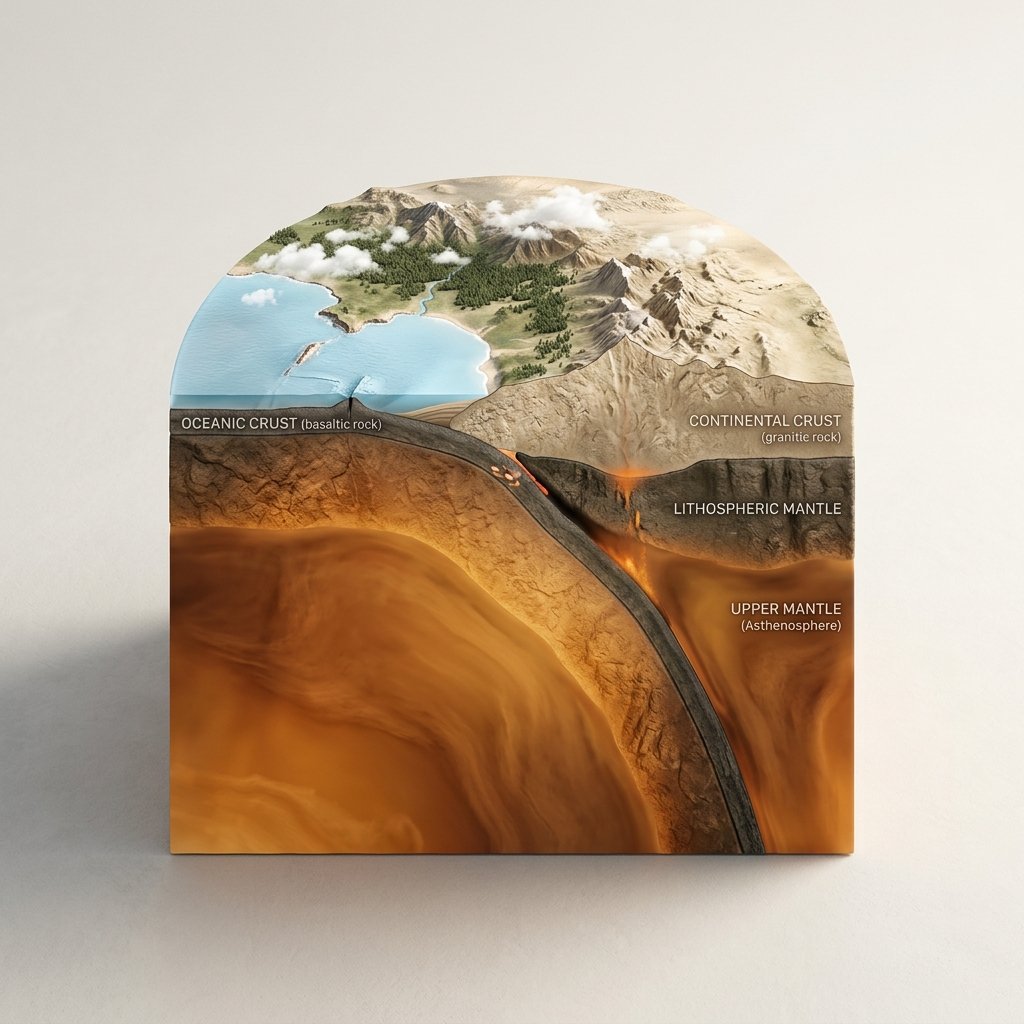
Earth’s outer shell is not one solid piece. It is broken into large slabs called tectonic plates, which float on the hotter, softer rock of the mantle beneath. These plates move a few centimetres a year, about as fast as fingernails grow. That slow motion explains earthquakes, volcanoes, mountain ranges and the position of the continents.
What the plates are made of
The plates include both the crust and the top part of the mantle, together called the lithosphere. Oceanic plates are denser and thinner. Continental plates are thicker and lighter, which is why continents sit higher than the ocean floor.
What drives the movement
Heat from Earth’s interior creates slow convection currents in the mantle. Hot rock rises, cools and sinks again. Plates are also pulled by their own weight where a dense oceanic plate sinks into the mantle at a subduction zone. Scientists think slab pull is a major force, with mantle convection playing a supporting role.
Three types of plate boundaries
- Divergent: plates move apart, as at mid-ocean ridges, where new crust forms.
- Convergent: plates collide. One may sink beneath the other, forming volcanoes and deep ocean trenches, or both may crumple upward to form mountains such as the Himalayas.
- Transform: plates slide past each other, as along the San Andreas Fault. These boundaries produce many earthquakes.
Evidence that the continents moved
The coastlines of South America and Africa fit together like puzzle pieces. Matching rock formations, fossils and ancient magnetic patterns in the ocean floor support the idea that continents were once joined in a supercontinent called Pangaea, which began to break apart about 200 million years ago.
Why it matters today
Plate boundaries are where most earthquakes and active volcanoes occur. Understanding how plates move helps scientists map seismic risk and plan building codes, though no one can yet predict exactly when an earthquake will strike.
Frequently asked questions
Are the continents still moving?
Yes. Plates move at a few centimetres a year, so the change is too slow to notice in a human lifetime, but measurable with GPS.
Will the continents join together again?
Models suggest the plates may come together again in about 200 to 250 million years, though the exact arrangement is uncertain.