










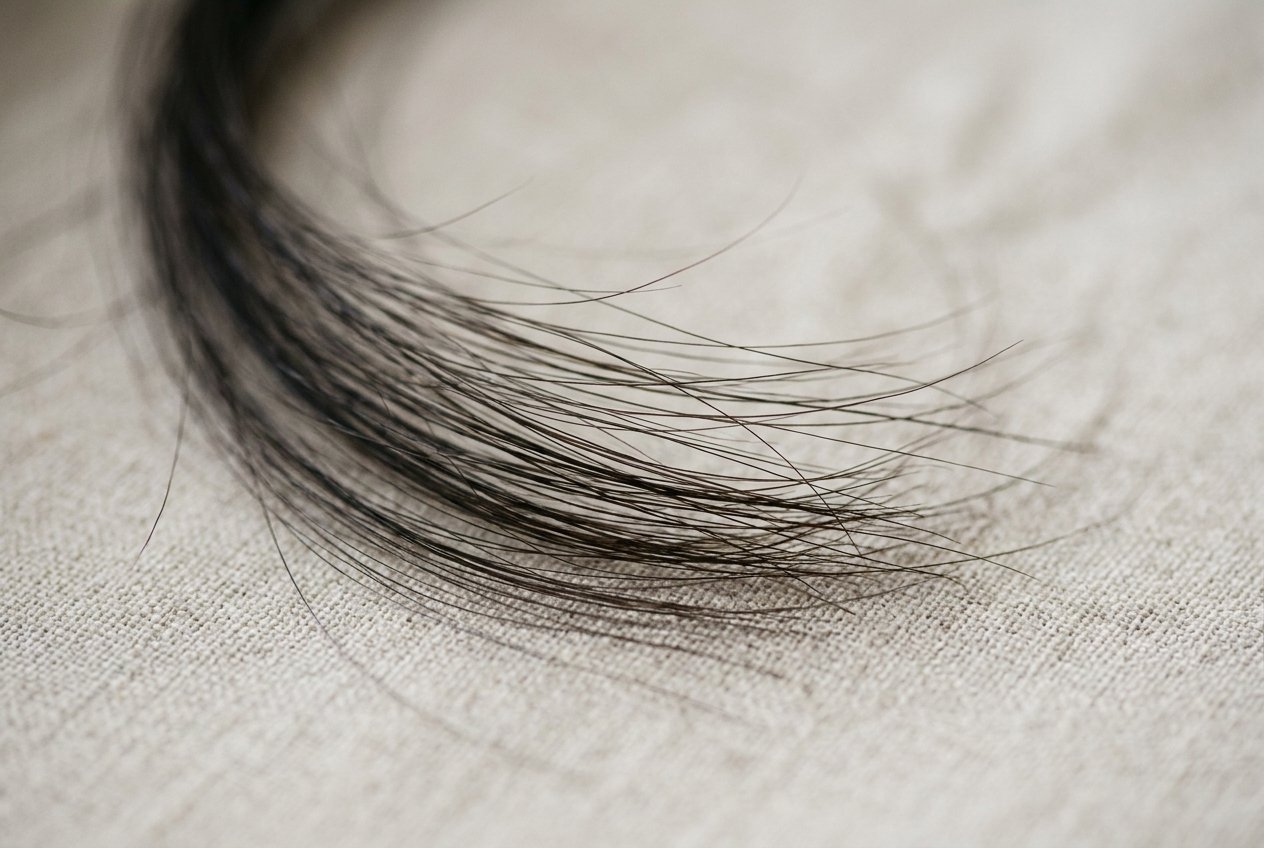
Hair loss is one of the few medical complaints people routinely treat as cosmetic rather than clinical. That matters, because the two most common causes respond to completely different approaches — and a third category signals something that needs investigating rather than treating with a shampoo.
Roughly a hundred hairs a day is normal shedding. What matters is not the number but the pattern: is it diffuse or patchy, is the hairline retreating, is there visible scalp, and did it begin gradually or over weeks. Each of those points to a different cause.
What is actually happening in the follicle
Hair grows in a repeating cycle:
| Phase | Duration | What happens |
|---|---|---|
| Anagen | 2–7 years | Active growth; 85–90% of scalp hair is here at any time |
| Catagen | 2–3 weeks | Growth stops, the follicle shrinks |
| Telogen | 2–4 months | Resting; the hair eventually falls out and a new one begins |
Two things can go wrong. The follicle can be miniaturised — each cycle produces a thinner, shorter hair until it produces nothing visible. Or the cycle can be pushed out of sync, sending a large number of hairs into the resting phase simultaneously, so they all fall out together a few months later.
The distinction explains why the timeline of hair loss is so often confusing: the trigger and the shedding are separated by two to four months.
10 causes of hair loss
1. Androgenetic alopecia (pattern hair loss)
Genetically determined sensitivity of follicles to dihydrotestosterone (DHT). Under repeated exposure the follicle miniaturises. It affects around half of men by age 50 and a substantial proportion of women by 65. This is gradual, patterned, and — untreated — progressive.
2. Telogen effluvium
A physiological shock pushes follicles into the resting phase. Shedding begins two to four months after the trigger and typically resolves on its own once it passes. Common triggers: major surgery or illness, high fever (including COVID-19), childbirth, rapid crash dieting, iron deficiency, thyroid dysfunction, and severe psychological stress.
It is the most alarming presentation — sudden, heavy, diffuse shedding — and usually the most reassuring.
3. Iron deficiency
Well documented as both a cause of telogen effluvium and an independent contributor to diffuse thinning, particularly in women. Ferritin matters here: hair loss has been reported at levels below roughly 30–40 µg/L even when haemoglobin is normal. This is the first blood test worth requesting — see our iron deficiency guide for the full panel.
4. Alopecia areata
An autoimmune condition in which T-cells attack the follicle. It produces sharply defined smooth patches, often starting at the scalp or beard, sometimes with nail pitting. It can be self-limiting or relapsing, and at its extremes causes loss of all scalp hair (alopecia totalis) or body hair. Lifetime prevalence is around 2%.
5. Traction alopecia
Repetitive tension from tight styling — tight ponytails, braids, weaves, cornrows, prolonged helmet use. Initially reversible; prolonged traction causes follicular scarring and permanent loss. It is entirely preventable by changing the style.
6. Trichotillomania
A compulsive hair-pulling disorder producing irregular, poorly demarcated patches at varying lengths. It is a psychiatric condition, not a habit to be corrected by admonishment.
7. Hormonal causes in women
PCOS causes androgen-driven thinning, usually with a widened central part while the frontal hairline is preserved. Postpartum hair loss is a form of telogen effluvium. Perimenopause changes the ratio of oestrogen to androgens. Androgen excess in women should also prompt consideration of rarer causes — see our PCOS guide for the work-up.
8. Thyroid disease
Both hypothyroidism and hyperthyroidism cause diffuse thinning, usually with other thyroid symptoms. Worth checking alongside iron.
9. Medication and medical treatment
Chemotherapy causes anagen effluvium — rapid loss during active growth. Other implicated classes include anticoagulants, retinoids, beta-blockers, some antidepressants, lithium, and excess vitamin A. Most medication-induced loss reverses after the drug stops.
10. Scarring (cicatricial) alopecia
The category that must not be missed: frontal fibrosing alopecia, lichen planopilaris, discoid lupus and related conditions destroy the follicle permanently. Warning signs are itching, burning, pain, redness, scaling, follicular plugging, or visible loss of follicular openings — the skin looks smooth and shiny rather than having visible pores.
Scarring loss is irreversible. Early treatment preserves hair that is still there.
How it presents differently
| Men | Women | |
|---|---|---|
| Pattern | Receding temples and crown, often merging | Widened central part, frontal hairline usually preserved |
| Scale | Hamilton-Norwood | Ludwig |
| Most likely cause | Androgenetic (overwhelmingly) | Androgenetic, iron, thyroid, PCOS, telogen effluvium |
| First tests | Usually none needed clinically | Ferritin, TSH, androgens if indicated |
Treatments with real evidence
Minoxidil 5%
Applied to the scalp daily, for men and women. It prolongs the anagen phase and increases follicle size. Expect slowed shedding first, visible change at four to six months. It must be continued indefinitely — stopping reverses the benefit over several months. The most common side effect is initial shedding in the first weeks, which settles.
Finasteride (men)
A 5α-reductase inhibitor reducing scalp DHT by roughly 70%. Slows progression in the large majority of men and produces visible regrowth in a meaningful proportion. Sexual side effects are reported in a low single-digit percentage of users and typically reverse on stopping. Not for women of childbearing potential. Dutasteride is a stronger alternative used off-label.
Anti-androgens (women)
Spironolactone is used off-label for female pattern hair loss and PCOS-related thinning. Combined oral contraceptives reduce free androgen by raising SHBG. Both require contraception and clinician supervision — spironolactone is teratogenic.
Alopecia areata
First-line is intralesional corticosteroid injection, which induces regrowth in patchy disease. For extensive or relapsing disease, topical immunotherapy (diphenylcyclopropenone), topical JAK inhibitors, and oral JAK inhibitors (baricitinib, ritlecitinib) are now established — the oral agents are the first treatments approved for severe alopecia areata.
Procedures
- Low-level laser therapy — modest evidence; may slow loss
- Platelet-rich plasma — growing but variable evidence, technique-dependent
- Hair transplantation — moves follicles from the DHT-resistant occipital region. Results are permanent and natural-looking, but it does not stop ongoing loss without medication, and expectations should be realistic about density
- Scalp micropigmentation — cosmetic, no growth, but effective for the appearance of density
What does not work
- Biotin, unless you are genuinely deficient. Deficiency is rare on a normal diet, and supplementation does not produce growth in people with normal levels. It is also worth knowing that high-dose biotin can falsely distort laboratory tests — including thyroid, hormone and cardiac troponin assays. Tell your doctor before bloods
- Most “hair growth” shampoos — these are cosmetic conditioning products. They may improve the appearance of existing hair; they do not alter the follicle cycle
- Supplements sold without testing — if the cause is ferritin, thyroid or PCOS, no amount of a botanical blend will address it
- Excessive washing — washing does not cause hair loss. What damages hair is traction, not cleansing
When to see a doctor
Book an appointment if you have any of the following:
- Patchy loss, especially smooth patches or loss of eyebrows or eyelashes
- Rapid shedding — clumps coming out in the shower or on the pillow
- Signs of scarring: redness, itching, burning, scaling, or skin with no visible follicular openings
- Associated symptoms: fatigue, weight change, cold intolerance (thyroid), irregular periods, acne or increased body hair (androgens)
- Signs of virilisation — deepening voice, increased muscle mass, male-pattern balding developing rapidly in a woman. This requires urgent endocrine assessment to exclude an androgen-secreting tumour
- Loss beginning before age 30, or a family history of early severe loss when you want to intervene
- Pain or pus — infection or inflammation needs treating
The practical reason to act early: most treatments preserve hair better than they restore it. The follicles you protect now are easier to keep than to bring back.
Frequently asked questions about hair loss
Is hair loss always permanent?
No — and this is the most important question. Telogen effluvium, traction alopecia (early), and most medication-related loss are reversible. Alopecia areata often regresses. Pattern hair loss is progressive without treatment. Scarring alopecia is permanent, which is why the warning signs above matter so much.
How long until a treatment shows results?
Plan for four to six months minimum, and often twelve. The hair cycle itself dictates this — no treatment can shorten the telogen phase on demand. That is also why supplements sold with two-week promises are not credible, and why stopping a legitimate treatment at week eight means you never see what it would have done.
Does stress really cause hair to fall out?
Yes, but with a two-to-four-month delay, which makes the connection hard to see. The stressful event, not the stressful week of shedding, is the trigger. This is also why people frequently mistake the shedding for the cause of their stress rather than its consequence.
Can washing or styling cause hair loss?
Washing does not. Tight, prolonged styles do — traction alopecia is genuine and can become permanent. So can constant heat damage, though that breaks the shaft rather than the follicle, which looks like hair loss but is a different mechanism.
Should I start minoxidil or finasteride now?
For clearly patterned loss, earlier intervention generally produces better outcomes because miniaturised follicles respond better than those already lost. But a blood count and ferritin first are inexpensive, and in women they frequently identify a correctable cause. A clinician can also confirm that your presentation is pattern loss rather than something else before you commit to years of treatment.
This article is for general information only and is not a substitute for professional medical advice. See our medical disclaimer.