










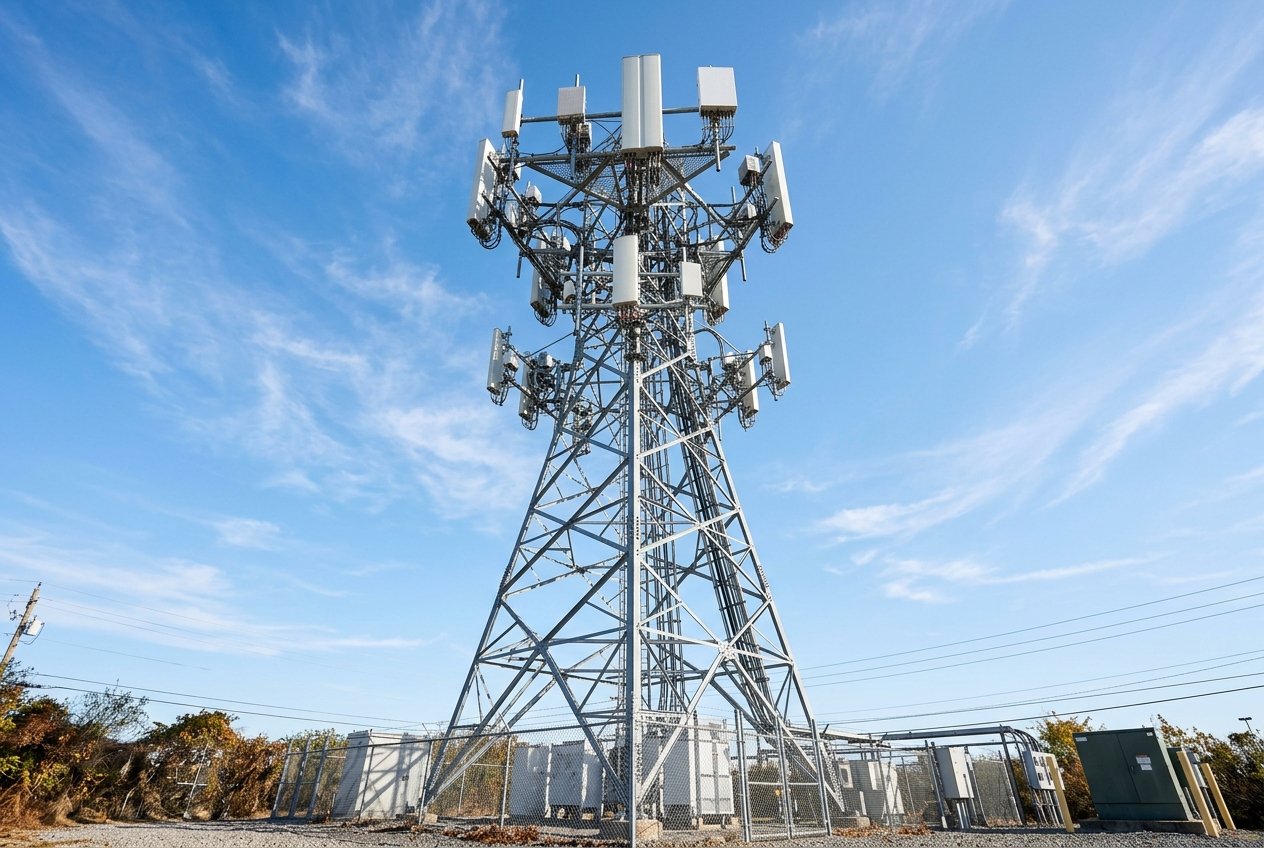
5G is the fifth generation of mobile network technology, following 1G through 4G. What makes it different from its predecessors is not one single improvement but three at once: more capacity for crowded places, much higher peak speeds, and a delay so short that the network can be used for things where waiting a fraction of a second matters.
It is also the generation with the most confusing marketing. Not all “5G” is the same speed, some of it is barely faster than 4G, and the version that produces headline numbers works over a range of a few hundred metres. Understanding the three bands explains almost every discrepancy you will notice in real life.
How 5G works
The three bands
| Band | Frequency | What it does well | Trade-off |
|---|---|---|---|
| Low band | Below 1 GHz | Long range, good building penetration | Speeds close to 4G |
| Mid band (sub-6) | Approx. 1–6 GHz | The real-world sweet spot: big speed gains with usable range | Needs many more sites than low band |
| mmWave | Approx. 24–100 GHz | Enormous capacity and very high speed | Short range, blocked by walls, glass, rain and even hands |
Most people who get genuinely fast 5G are on mid band. If your “5G” icon appears but downloads feel ordinary, you are most likely on low band or on a signal refarmed from 4G.
Massive MIMO and beamforming
4G antennas broadcast over a wide area. 5G base stations use large arrays of small antennas to aim concentrated beams directly at your device. Rather than shouting across a room, the tower points a narrow signal at each phone. This raises capacity substantially in the same spectrum.
Network slicing
A 5G core can run several virtual networks over the same physical hardware, each with its own characteristics. One slice can prioritise low latency for industrial control, another bulk throughput for video, another ordinary phone traffic. This is the feature that matters most for factories, hospitals and vehicles, and least for browsing.
Non-standalone vs standalone
Early 5G used existing 4G for signalling and 5G only for the data connection — non-standalone. Standalone 5G replaces the core entirely and is required for the full feature set including slicing. Many networks are still partway through the migration.
Real-world 5G speeds
The ITU’s IMT-2020 requirements set a peak of 10 Gbps downlink and a 1 ms air-interface latency target. Those are engineering ceilings, not what your phone sees.
In practice:
- Low band: often comparable to good 4G, sometimes 20–50% better
- Mid band: typically 100–500 Mbps downlink in real use, higher in ideal conditions
- mmWave: 1–4 Gbps demonstrated, but only with a clear line of sight nearby
- Latency: usually 10–30 ms in deployed networks rather than the theoretical 1 ms
Speed also depends on the backhaul connecting the tower to the internet. A 5G radio hanging off a congested fibre link will not deliver 5G speeds.
5G speed at a glance
How fast is 5G compared with 4G?
Mid-band 5G is commonly 100 to 500 Mbps in real use, usually well above typical 4G. Low-band 5G is often close to 4G, and mmWave can reach 1 to 4 Gbps in short-range, ideal conditions.
- Low band 5G: often close to good 4G, sometimes a little faster.
- Mid band 5G: commonly 100 to 500 Mbps.
- mmWave 5G: 1 to 4 Gbps in ideal, short-range conditions.
If your phone only shows low-band 5G, expect speeds similar to 4G. Check which band your carrier is using before you judge the network.
What 5G is actually for
Crowded places
The most immediate benefit is capacity. Stadiums, stations and city centres where 4G grinds to a halt are precisely where 5G’s additional capacity shows up first. You may have noticed better speeds at an event and worse speeds at home — that is the pattern.
Applications where delay matters
Remote surgery, industrial robotics, connected vehicles and competitive gaming all care about round-trip time more than raw megabits. The latency improvement is where 5G differs most structurally from 4G.
Dense Internet of Things deployments
Sensor networks, smart meters and city infrastructure need many connections per cell rather than a few phones. 5G was designed with connection density in mind.
Fixed wireless access
5G can deliver home broadband over the air. In areas where laying fibre is expensive, this gives real competition to existing providers without any construction in the street.
Do you actually need a 5G phone?
For everyday tasks — messaging, social media, maps, streaming at standard quality — 4G remains sufficient almost everywhere. The cases where 5G genuinely changes the experience:
- You regularly work from crowded venues or commute on congested trains
- You rely on your phone as a primary connection, including hotspot use
- You are in an area with real mid-band or mmWave coverage from your carrier
- You need low latency for a specific application
If none of those apply, a 5G upgrade will mostly cost you battery and money. Coverage checkers from your carrier are more reliable than any general claim about 5G being “available”.
Common 5G claims, examined
“5G is dangerous”
5G uses radio waves in the non-ionising part of the spectrum — the same broad category as 4G, FM radio, Wi-Fi and visible light. Non-ionising radiation does not have enough energy per photon to break chemical bonds or damage DNA. The WHO and ICNIRP maintain exposure limits based on the known thermal effects, and 5G base stations operate within them. The mmWave frequencies are absorbed in the outer layers of skin rather than penetrating the body.
There is no established mechanism by which 5G at permitted exposure levels causes harm, and no credible evidence that it does.
“My 5G is just 4G with a different icon”
Sometimes genuinely true. Dynamic spectrum sharing lets a carrier run 4G and 5G simultaneously on the same frequency, which in early rollouts produced 5G with 4G-level performance. This is a deployment reality, not a conspiracy.
“5G will replace Wi-Fi”
Not in homes. In-building 5G is attenuated by walls, and per-megabit cost favours Wi-Fi indoors. The likely long-term arrangement is both: Wi-Fi for fixed locations, 5G for mobility and coverage gaps.
Security considerations
5G improves on 4G in several respects — mutual authentication between device and network, encrypted identity fields, and stronger subscriber protection. As with any connectivity layer, the practical risks are in the devices and applications on top of it rather than in the radio technology itself. Our website safety checks guide covers the layer where most people actually get caught out, and a VPN still has a role on any network you do not control.
For background on the computing workloads that faster networks enable, our explainer on what quantum computing is covers where that field actually stands.
What changes for ordinary users
- Better speeds in busy places — the most reliably noticeable improvement
- Faster downloads and uploads on mid-band, where available
- Slightly higher battery use when searching for a 5G signal in weak coverage
- More competition in home broadband where fixed wireless is offered
- Less visible but more significant: industrial, medical and infrastructure applications enabled by low latency
Frequently asked questions about 5G
Is 5G faster than Wi-Fi?
Outdoors and in good coverage, mid-band 5G can beat a busy or poorly positioned router. Indoors, Wi-Fi usually wins on both speed and cost. They serve different situations rather than one replacing the other.
Does 5G drain my battery?
In weak or transitional coverage, yes — the modem works harder maintaining the connection. In strong coverage with an efficient modem the difference is smaller. If battery life is a concern and coverage is patchy, forcing 4G is a reasonable trade.
Will 5G work through walls?
Low and mid band will, with reduced signal. mmWave generally will not — it is readily blocked by glass, brick, foliage and even a hand covering the antenna. That is why mmWave deployment is concentrated in small outdoor hotspots.
When will 5G be everywhere?
Coverage of some form is already widespread in many countries; uniform high-speed mid-band coverage is a denser and more expensive build. Expect continued gradual improvement rather than a moment where it is simply “finished”.
This article explains general technology concepts and is not professional advice.






[…] What Is 5G? How It Works, Speeds, and When You Need It […]